
Introduction: a free consultation is an information service, not a product promise
The query “which hair extension companies offer free consultations” sounds like a request for a short list. In reality, most people asking it are trying to reduce three risks before they spend money: selecting the wrong method, receiving a shade that does not blend with their own hair, or committing to maintenance they cannot realistically keep up with. A useful consultation should make those risks visible before an order or installation is scheduled.
Companies, salons and online extension specialists use the word *consultation* differently. It may be a short email exchange, a video call around reference photographs, an in-salon assessment that includes a colour comparison, or an appointment whose fee is credited to a later service. It may also be a sales conversation with no physical inspection. None of these formats is automatically better. The important point is whether the provider states what is included, what remains to be confirmed, and what the next step costs.
This guide does not rank individual companies or say that a particular provider offers a free service. It gives consumers, salon teams, retailers and professional purchasers a way to compare the consultation itself. Use it to prepare better questions, judge the information you receive, and leave the discussion with a recommendation that can be checked rather than vaguely remembered.
What a credible hair extension consultation should cover
A professional conversation begins with the wearer’s existing hair and routine, not a generic promise of length or volume. The consultant should ask about the desired result, natural-hair density, colour history, texture, styling habits, lifestyle and willingness to return for maintenance. A salon, retailer or purchasing team uses the same logic at range level: who will wear the product, which application method will be offered, and what aftercare support can actually be delivered?
The discussion should separate five decisions:
- **Application goal:** length, volume, colour dimension, a special-event look, or an ongoing salon service.
- **Method suitability:** clip-ins, tape-ins, wefts, keratin bonds or another method, considered against the intended application rather than a fashion label.
- **Product specification:** hair material, texture, colour reference, length, pack configuration and attachment construction.
- **Installation preparation:** condition of the natural hair, appointment plan, tools or accessories needed, and the professional’s preparation advice.
- **Care and removal:** washing, drying, heat styling, brushing, storage, maintenance timing and whether professional removal is recommended.
Ask the consultant to distinguish an observation from a commitment. “This shade family may be suitable” is not the same as “we have reserved colour code X.” “Tape-ins may work for your goal” is not a confirmed installation plan. This distinction is not evasive; it is a sign of trustworthy advice when individual hair, lighting and installation technique create variables.
Free, credited, remote or in-salon: compare the scope, not the headline
Get a QuoteBefore booking, ask for a plain-language description of the appointment. A free remote consultation can be valuable for an early product discussion, especially when a buyer can send daylight photographs and a clear brief. It cannot fully replace an in-person check of natural hair, a physical colour ring or a professional assessment of installation suitability.
An in-salon consultation may offer more direct observation. Buyers should still ask whether the hair is physically colour-matched, whether a strand or product sample is available, and whether the appointment produces a written recommendation. Some providers charge an assessment fee and apply it later to an installation. That can be a reasonable model if it is stated before booking; it should not be confused with a fully free service.
For online companies, a strong process often has stages: a brief or qualification form, current photographs taken in natural light, a discussion of colour and construction options, then a written product or service proposal. The proposal should record what was discussed and show the variables still open. If the only output is “we recommend our best seller,” the buyer has not received enough evidence to compare alternatives.
| Consultation format | Useful for | What it cannot confirm alone | Questions to ask |
|---|---|---|---|
| Email or chat | Product range, initial questions, method comparison | Exact shade and installation suitability | Who reviews the brief? Will I receive a product reference? |
| Video consultation | Goal setting and reference-photo review | Physical colour match and tactile inspection | What lighting and photos should I provide? Is a sample step offered? |
| In-salon consultation | Natural-hair review and service planning | Future result if product details remain open | Which details are confirmed today and recorded in writing? |
| Buyer or trade consultation | SKU planning, sampling and application training | Consumer fit for every end user | Which sample, factory-testing or shipment-inspection checkpoints can be agreed? |
Build a consultation brief before you speak to a company
The best consultations are prepared. You do not need technical vocabulary, but accurate context matters. Take two or three current photographs in natural daylight: one from the back, one from the side, and one showing the mid-lengths and ends. Avoid filters, strong indoor lighting and screenshots that alter colour. Bring inspiration images as a communication tool, not as a promise that the same result is achievable on every hair type.
For an installation conversation, list previous colour services, chemical treatments, recent breakage concerns, scalp-sensitivity information you wish to raise, and the time you can devote to maintenance. A remote consultant should not be expected to diagnose hair or scalp conditions. Where suitability is uncertain, seek appropriately qualified professional advice before proceeding.
For a salon, retailer or private-label buyer, translate customer requirements into a product brief: target market, intended application, texture family, shade range, length ladder, pack contents, packaging and replenishment needs. A factory-testing or shipment-inspection conversation is meaningful only when the approved reference, tolerance and checkpoint are defined. “Premium quality” is not a testable specification.
Questions that reveal whether the consultation is useful
A consultation should make options easier to compare after the call. These questions move a discussion from marketing language to a documented recommendation.
Questions about the product
- What is the exact product name, construction, texture, length and colour reference being discussed?
- What does one set or pack include, and what is not included?
- Is the recommendation based on a supplier specification, colour ring, sample or online image only?
- What care instructions apply to this attachment method and material?
Questions about application and maintenance
- Who is expected to install or remove the product, and what preparation is needed?
- Which parts of the outcome depend on the installer, the natural hair and the selected product?
- What maintenance appointments, tools or replacement items should be planned?
- What is the stated process if fit, colour direction or attachment feels unsuitable?
Questions about ordering and service terms
- Is the consultation free, credited or connected to a later purchase? Ask for terms in writing.
- When does a recommendation become an order, and how are changes handled?
- If a sample is involved, what reference controls the final order?
- If goods are shipped, what inspection record, packing list and destination-market responsibilities are agreed?
None of these questions asks a provider to guarantee an outcome. They ask for product identity, process and responsibility—exactly the information a high-consideration purchase needs.
Assess colour, texture and construction without over-relying on photos
Get a QuotePhotographs are useful but incomplete. A product image can show a general colour family, length and styling direction; it cannot reliably establish an exact match in every light. Cameras, screens and editing change colour perception. Ask whether the recommendation relies on a physical colour ring, a sample, a current batch reference or an image comparison. If it is image comparison, keep that limitation in the order record.
Texture needs the same discipline. “Straight,” “body wave” and “curly” are broad descriptors. Ask how the texture is presented after washing, whether it has been heat-styled for photography, and how it should be handled in ordinary use. For a salon team, one sample does not eliminate the need to document a texture expectation for replenishment.
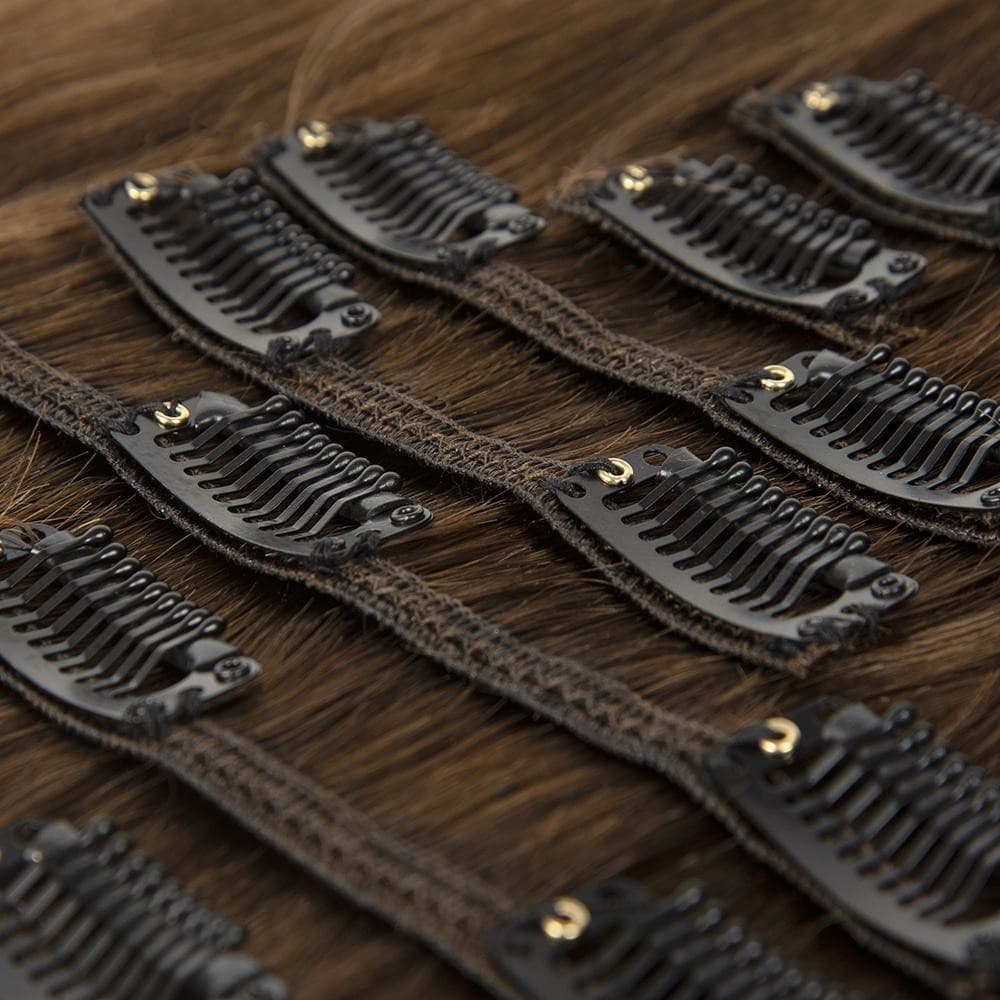
Attachment construction shapes application and removal. Tape-ins use adhesive tabs; clip-in sets use pressure clips; wefts require an installation method selected by the professional. A thoughtful consultant can explain the functional difference without claiming that one method is universally suitable. Product application should follow the wearer, the installer’s practice and the documented product guidance.
When a buyer should pause rather than place an order
More information is worth more than a quick checkout when the provider cannot identify the recommended shade or length, cannot explain pack contents, gives contradictory installation advice, or pressures the buyer to decide without a written summary. Pause if “free” is used to avoid explaining a later service or product charge.
Trade buyers should pause if a supplier cannot align a quotation to an approved sample reference, name packaging assumptions or define what will be checked before dispatch. An agreed shipment inspection is not a broad quality claim. It is a checklist tied to an approved product reference, carton marking, count, visible condition and other mutually defined points. It should not be presented as a guarantee that no issue can ever arise in transit or use.
Reliable companies and consultants are comfortable with precise questions. Their authority comes from clear information, stated boundaries and a repeatable process—not from promising certainty where the evidence cannot support it.
Turn the conversation into a decision record
After the consultation, write down what is known, what is assumed and what needs a later check. This is useful for an individual buyer because it makes a follow-up call more efficient. It is essential for a salon, retailer or importer because a handover between team members should not depend on recollection. A practical record can be one page long and include the consultation date, contact channel, goal, proposed method, product reference, texture, colour reference, length, pack scope, care points, quote or service scope, and unanswered questions.
Separate *confirmed* fields from *to be confirmed* fields. For example, a buyer may confirm that the intended application is occasional volume but still need to choose between two colour references. A salon may have agreed a service goal but need a physical sample before final product approval. A trade buyer may have approved an initial sample but still need to confirm packaging artwork or carton marks. This clarity prevents an early consultation from being treated as a final specification.
For a company comparison, use the same record for every provider. Then evaluate the quality of the consultation by evidence, not charm: Did the consultant identify an exact product? Explain why a method was considered? State what a photo could and could not confirm? Provide care and ordering information? Invite the buyer to review an open point rather than pushing an immediate checkout? A provider who documents these points gives the buyer a more reliable basis for a decision even when its consultation is not the shortest or most promotional.
If you are purchasing for customers, add a feedback field after the first product application or sample review. Capture the observable issue—such as shade direction, pack configuration, placement feedback or packaging clarity—and link it to the original reference. This creates a genuine experience record over time without inventing case-study results. It also helps the next consultation become more specific and useful.
The record is also a practical E-E-A-T safeguard. Experience is represented by the actual observations collected after a product trial or application, not by a fictional testimonial. Expertise appears in the way construction, colour reference, preparation and care are separated. Authority comes from following a consistent comparison method. Trust is protected when the record states uncertainty rather than filling gaps with a reassuring but unsupported answer. Buyers should expect this level of clarity from any provider handling a premium, high-consideration request.
FAQ
Does a free consultation mean the extensions or installation are free?
No. It usually describes the conversation itself. Confirm separately whether matching, samples, installation, products, shipping or follow-up appointments are included, credited or charged.
Can an online consultation provide an exact colour match?
It can narrow colour direction with current daylight photographs, but an online image alone may not establish an exact match. Ask which reference is used and whether a physical colour or sample step is available.
What should I send before a remote consultation?
Send unfiltered daylight photos, inspiration images, your desired result, expected maintenance level and any relevant colour history you choose to disclose. Ask the provider which photographs or measurements it needs.
What should a salon or retailer document after a consultation?
Record construction, texture, colour reference, length, pack configuration, application plan, care guidance, stated scope and open questions. This supports client communication, ordering and repeat service.
Is a consultation enough to approve a wholesale or private-label order?
Usually not alone. A business order should move from consultation to a written specification, sample or approved reference, quotation, packaging confirmation and mutually agreed production or shipment-inspection checkpoints.
Conclusion
The strongest answer to “which hair extension companies offer free consultations” is not a universal brand list. It is a way to judge whether the consultation will help you make a better decision. Compare the scope, prepare truthful references, request a written recommendation and keep product details separate from marketing claims. Whether the conversation is free, credited, remote or in person, it should leave the buyer with clearer next steps and fewer hidden assumptions.
LET'S TALK ABOUT YOUR PROGRAM
Ready to turn product questions into a clearer brief?
Share your target customer, product category and requirements. Our team will help structure the next sample or quotation conversation.