
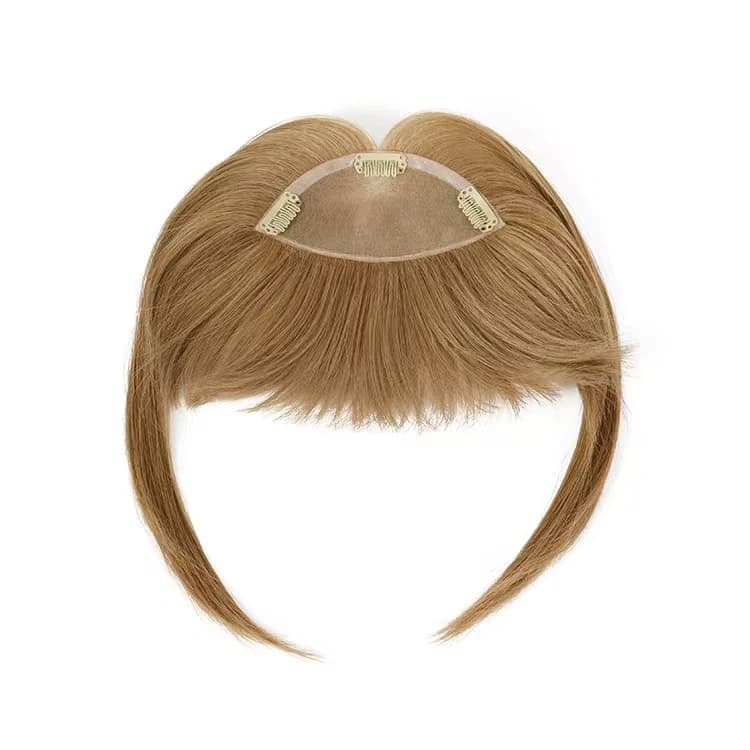
Choose clip-in bangs by matching the hair color, checking the coverage you actually need and confirming that the clips can attach comfortably to suitable existing hair. A fringe that looks right in a product photograph can still have the wrong base shape, side length or attachment layout for the wearer.
For salons, hair brands and distributors, the goal is a specification that can be sampled, fitted and reordered. Start with the intended hairstyle, then approve the complete hairpiece rather than choosing only by a shade name or clip count. A small fringe and a larger topper can both use clips while solving different coverage problems.
WinningWigs' virgin human hair clip-in bangs are made to order with monofilament, also called mono, or stretch mesh bases. The minimum order is 1 piece, with approximately 3–4 weeks for production. This guide uses the supplied product photographs and confirmed order information; fitting checks described below are recommendations, not claims of completed wearer trials.
What are clip-in bangs, and who are they for?
Clip-in bangs are removable fringe hairpieces attached with clips. Clip-on bangs and clip-in fringe commonly describe the same general product type. Designs vary: some concentrate on the forehead fringe, while others include longer side sections, a visible part or a wider top area.
They can suit a temporary style change, a salon fringe consultation or a retail range offering different face-framing options. A customer may want a straight fringe, a softer curtain shape or sides that blend into an existing haircut. Record that intended result before discussing the construction.
For product application, distinguish appearance from attachment. The hairpiece must blend visually, and the chosen anchor points must support the selected piece. Photographs alone cannot establish comfort, suitability for thinning hair or the finished result on an individual customer.
Decide between a fringe hairpiece and a topper
Map the area that needs coverage
Ask whether the customer wants bangs across the forehead, extra hair around the front part or broader coverage over the top. Mark the intended placement on a consultation photograph or fitting diagram. Include the existing part and the proposed clip positions.
A fringe may be appropriate when the brief focuses on the front and sides. When the requirement extends farther across the top or crown, compare a mono topper and its actual base dimensions. Product names overlap, so compare measured coverage rather than assuming all items labeled bangs or topper have the same outline.
| Selection question | Clip-in bangs | Broader topper format |
|---|---|---|
| Main styling brief | Fringe and face-framing hair | Coverage over a specified top or crown area |
| Base assessment | Front placement, perimeter and side sections | Complete coverage area and perimeter placement |
| Attachment review | Available hair at the proposed clip points | Available hair around the selected base outline |
| Blending check | Fringe, sides, part and connection edge | Top distribution, part and surrounding lengths |
Avoid selecting by clip count alone
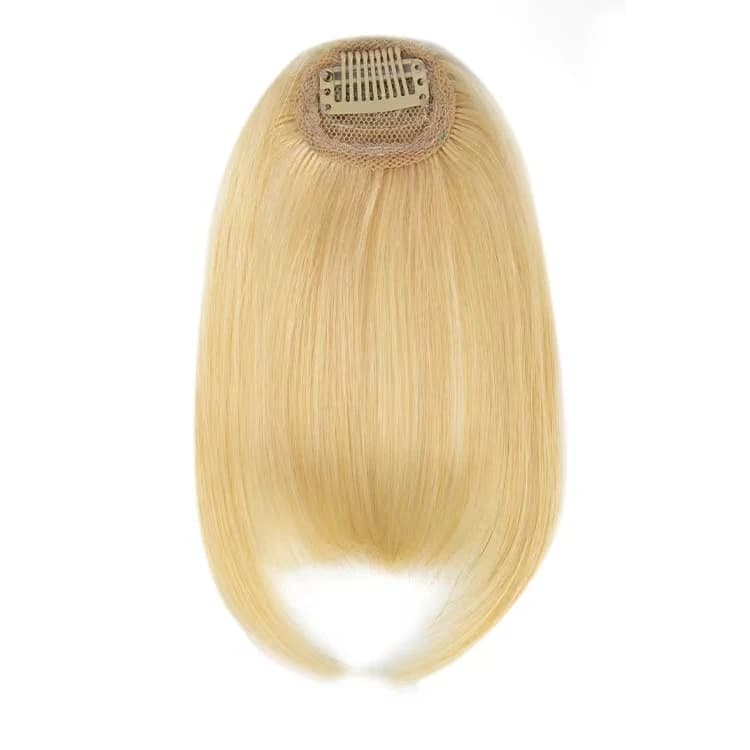
The supplied photographs include compact one-clip and wider three-clip references. These are different configurations, not a performance ranking. A wider base can cover a different area, but more clips do not automatically mean a better fit or a less visible connection.
Jon Renau's professional topper chart separates base dimensions, placement, fiber and attachment across its designs. That provides useful context for comparing formats; its dimensions and materials are not WinningWigs specifications.
Match the color where the hairpiece meets natural hair
Compare depth, tone and color distribution
Match the hair that will sit next to the fringe, including the front, temples and part. The ends of a customer's longer hair may be lighter than the hair beside the attachment. Using only the overall length color can create a noticeable difference at the connection.
Describe whether the target is darker or lighter, warmer or cooler, uniform or blended. For rooted or highlighted hair, identify the darker area and the position of lighter sections. Gray blends also need a distribution reference; a photograph of a gray-looking piece does not establish a gray percentage.
Use a physical swatch or approved sample when possible. If photographs are the starting point, request clear front, side and top views in consistent lighting without filters. Compare the piece in the intended hairstyle. Screens, camera processing and salon lighting can change the perceived shade.
Record the reference that controls the order
Name the selected photograph or swatch in the enquiry, then identify the approved sample once available. Supplier shade numbers are not universal conversions. Resolve conflicting references before production, especially where a bright front photograph differs from the part or side view.
WinningWigs identifies this product's hair material as virgin human hair. Confirm the finished shade, any coloring or texture processing and the corresponding care instructions separately. The material description and a blonde or gray photograph do not establish that a finished colored piece has undergone no processing.
Compare mono and stretch mesh as complete constructions
What to check on a mono base
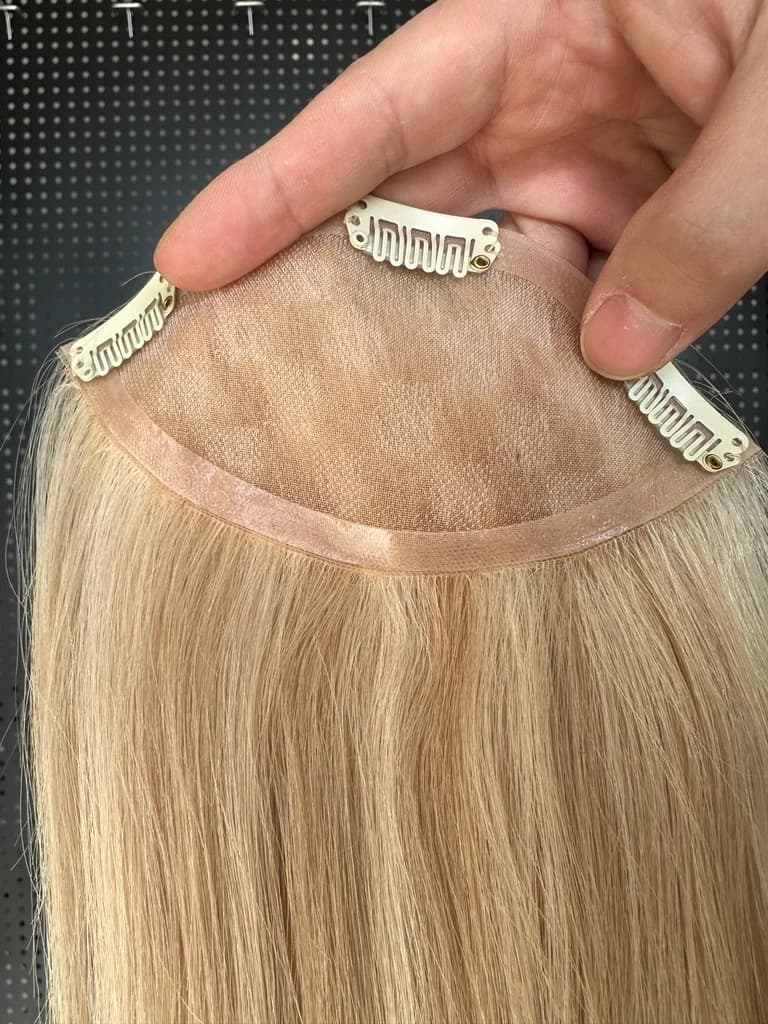
Monofilament, or mono, is one available base option. Ask for the complete outline, width and front-to-back depth with units, plus a clear underside photograph. Review the visible part, hair direction, perimeter and clip locations together rather than treating the base name as a complete specification.
If the customer wants to move the part or sweep the fringe sideways, assess that movement on the sample. A photograph of one parting position cannot establish unlimited styling flexibility. Confirm which direction and finished shape are being approved.
What to check on stretch mesh
Stretch mesh is the other available option. Confirm the panel, edge finish and clip layout for the selected design. Ask how dimensions are measured and whether a measurement refers to the relaxed base; inconsistent measuring conditions can make sample comparisons unreliable.
Neither base label guarantees an invisible edge or universal comfort. The complete construction, placement and surrounding hair determine the practical result. The photos in this guide show construction details but do not independently identify every pictured panel's material. Specify the selected option in writing.
Prepare and fit the attachment before cutting
Installation preparation starts with a placement assessment. A qualified hair professional should check the intended anchor points, surrounding hair and the hairstyle that will cover the connection. Do this before trimming the fringe or making other irreversible alterations.
Use the instructions supplied with the selected design. The following is a fitting sequence to discuss with the professional, rather than a fixed installation method for every clip mechanism:
- Identify the front, sides and intended part while the clips are open.
- Position the base and compare its coverage with the agreed brief.
- Separate the hair needed for the specified anchor points and surrounding blend.
- Secure the clips according to their instructions without forcing them or trapping excess hair.
- Check the edge, fringe fall and comfort while looking forward, turning and lowering the head.
- Release and reassess any placement that slips, pulls or prevents the planned hairstyle.
Avoid solving a poor fit by tightening the attachment or repeatedly pulling on the same small area. The American Academy of Dermatology explains that repeated pulling can cause traction alopecia and identifies pain and stinging as warning signs. Stop using a painful attachment; unexplained or ongoing hair loss warrants a dermatologist's assessment.
For removal, release the clips before lifting the base away and gently free any caught strands. Do not pull the hairpiece off while clips remain engaged. Obtain the selected product's guidance on wear duration and storage rather than assuming it is intended for sleep or continuous wear.
How to conceal the connection and blend the fringe
Check placement and hair direction first
A visible connection can reflect placement, color mismatch, an unsuitable base outline or insufficient blending hair. Assess the top and both sides in ordinary room lighting, then compare the part in the hairstyle the customer will actually wear. A single front-facing mirror check can miss a lifted side edge.
Where the design allows it, a professional can arrange surrounding hair over the connection and align the hairpiece's direction with the natural part. Do not add glue or tape to a base specified for clips without explicit product approval. If concealing the edge requires an unsuitable placement, reconsider the construction or coverage format.
Blend the fringe and side lengths on the wearer
Confirm the intended fringe line and side sections before cutting. A curtain shape, a fuller straight fringe and a shorter wispy effect require different distributions. Check how the piece falls with glasses, tucked sides and the customer's usual part.
Any professional trimming should follow an approved fit and the agreed alteration terms. Cutting on a display head alone may not reproduce the wearer's forehead shape or the way the piece sits. Human hair also does not imply unrestricted bleaching or heat styling; follow the instructions for the finished hair and base.
Troubleshoot before changing the specification
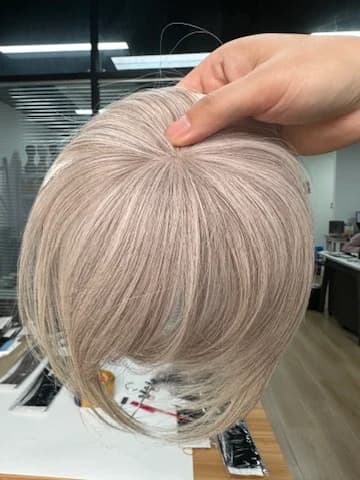
If a sample does not blend, identify the cause before requesting a replacement. Keep the comparison in the same hairstyle and lighting so that a revised shade or base can be assessed meaningfully.
| Observation | What to review first |
|---|---|
| The fringe looks lighter at the connection | Compare the adjacent front hair and root reference, rather than only the longer ends |
| A side edge lifts | Reassess base shape, placement and clip engagement with the professional |
| The part looks fuller than expected | Review hair distribution and the approved part direction before cutting |
| The piece shifts with normal movement | Check the anchor points and complete fit; avoid compensating by adding tension |
Build a sample and shipment inspection checklist
Approve observable details
For factory testing or sample review, agree what will be checked and how findings will be recorded. Useful observations include clip opening and closing, attachment stitching, base edges, measured dimensions, hair direction and shade comparison. Do not describe a piece as having passed a quantified durability test unless the method and results exist.
Keep the approved sample identifiable. Photograph the underside and top, note the reference color and record fringe and side lengths using agreed starting points. Ask for the finished weight if it matters to the brief; do not infer grams or density from an image.
If washing or styling is part of sample approval, agree the permitted procedure and acceptance criteria beforehand. Record the products and handling used. A showroom photograph cannot establish wash performance, shedding rate or service life, and an informal observation should not become a universal performance claim.
Use a clear customer brief
An illustrative salon brief might request the three-clip photo reference with a mono base, a physical color match, a curtain-style fringe and longer sides for professional blending. The salon would still need to supply dimensions, length references, quantity and destination. This is a planning example, not a reported customer project.
For shipment inspection, compare the received pieces with the accepted sample and written requirements before washing or trimming. Check identification, quantity, shade, dimensions, clip condition and packing. Record discrepancies with clear photographs and contact the supplier before altering an item that may need review.
Confirm MOQ, production and the complete quotation
The confirmed WinningWigs minimum for this product is 1 piece. It is made to order, with approximately 3–4 weeks for production. Confirm when the production period starts for the approved specification and allow separately for shipping, customs and any salon fitting appointment.
Do not apply the minimums or dispatch times of regular hair extensions or full wigs to this fringe product. Request the selected configuration's sample price, shipping charge, packaging options and alteration or return conditions. A one-piece minimum does not establish a fixed price for every color and base combination.
Include these customer requirements in a quotation request:
- Selected product image and intended fringe shape.
- Mono or stretch mesh, base outline and dimensions with units.
- Clip layout and the coverage or placement requirement.
- Color reference, part, fringe and side-section lengths.
- Desired fullness, quantity and destination.
- Required date and any label, packaging or sample-approval needs.
For a repeat order, quote the accepted sample identifier and describe every change explicitly. A new color, different side length or revised clip position should be reviewed against the brief instead of being treated as an automatically equivalent piece.
FAQ
Are clip-on bangs and clip-in bangs different?
They commonly refer to the same general format: a removable fringe hairpiece with clips. Compare the actual base, coverage and side sections because the terminology alone does not identify one construction.
Can clip-in bangs work with thin front hair?
Suitability depends on available hair at the intended anchor points, the piece and the placement. Have a qualified professional assess the fit. Do not assume a compact base or extra clips make every design suitable for thinning hair.
How do I hide the top edge?
Start with the right base outline, placement, color and part direction. Depending on the design, surrounding hair may help blend the connection. If the edge remains exposed in the required hairstyle, reassess the product rather than relying on a front photograph.
Should I choose one clip or three clips?
Select the coverage and complete construction first. The product photos show both configurations, but clip count is not a comfort or security rating. Confirm the exact layout and assess the sample in the intended position.
Can I color or cut the bangs?
Discuss the finished hair's processing, care instructions and alteration terms before ordering. Professional trimming can be planned after fitting. Further coloring and heat treatment require product-specific guidance; the human-hair category alone is not an approval for either.
What are the order minimum and lead time?
WinningWigs confirms a minimum of 1 piece and approximately 3–4 weeks of made-to-order production for this product. Confirm the agreed specification and schedule in the quotation. Shipping, customs and local fitting time are additional.
Conclusion
The right clip-in bangs combine an appropriate shade, sufficient coverage and an attachment that suits the intended placement. Compare the base, hair direction, fringe and sides as one hairpiece. If the brief requires broader top coverage, review a topper before committing to a small fringe.
For a salon or brand, approve a sample and retain the measurable details for inspection and reorders. Start with the WinningWigs clip-in bangs product page to compare the supplied references and confirmed order options.
LET'S TALK ABOUT YOUR PROGRAM
Ready to turn product questions into a clearer brief?
Share your target customer, product category and requirements. Our team will help structure the next sample or quotation conversation.