
Introduction: evidence comes before conclusions
When a customer reports tangling, dryness, visible shedding, colour concerns, curl changes or an attachment issue, the fastest response is not always the best response. A supplier, salon or brand can damage trust by immediately blaming customer care, production or shipping without enough evidence.
A better response is an evidence-based investigation. It identifies the affected product, preserves the condition in which the issue was found, collects the relevant customer requirements and use history, compares the item with the approved reference and separates observations from possible causes. This process does not make every issue simple. It makes the conversation more fair, more traceable and more useful for corrective action.
This guide applies to human hair extensions, wigs, toppers and other professional hair products. It is designed for B2B buyers, salon owners, distributors, product developers and supplier teams. It does not promise that every concern has one cause or that every future order can be free of variation. Its purpose is to replace guesswork with a disciplined review.
Start with product identity, not a general complaint
The first question is simple: which exact product is affected? A report such as “the hair is dry” is difficult to investigate unless it can be connected to a product, order and product application.
Collect the available details:
- Order number and delivery date
- Product or SKU name
- Batch reference where available
- Colour, length and texture reference
- Attachment, cap or base construction
- Quantity affected
- Date the issue first appeared
- Customer photographs or videos
- Approved sample, colour ring or written product reference
If several products are involved, separate them by SKU, colour, texture or order. A rooted blonde tape-in should not be treated as identical to a dark straight weft simply because both came from one shipment. This first step helps the team see whether the issue is isolated, connected to a product version or still too broadly described to interpret.
Preserve the condition before attempting a correction
Get a QuoteWhen possible, ask the customer, salon or service team to document the product before washing, recolouring, cutting, conditioning or restyling it. The goal is not to create a burden. It is to preserve the evidence that may help both sides understand what happened.
Useful documentation can include photographs of the overall product condition, roots, mid-lengths, ends, attachment construction, areas with tangling or dryness, visible colour direction and product labels or packaging where still available. A short video can be useful when it shows a specific observation, such as combing resistance, rather than a general impression.
If goods are returned, record their received condition before any further treatment. Note whether the item was dry, wet, styled, washed, altered or exposed to heat. A product can change during handling, so early documentation creates a clearer basis for later comparison.
Gather installation, use and care context neutrally
Human hair products are used in different ways. A professional-installed tape-in program, an occasionally worn clip-in set, a wig exposed to heat styling and a topper worn daily do not have the same handling history. The purpose of context questions is not to assign fault to the customer. It is to understand the product application and care conditions that may relate to the observation.
Ask neutral questions:
- How was the product installed or fitted?
- Was it applied by a professional or at home?
- What washing and conditioning products were used?
- Was it exposed to heat styling, recolouring, toning or chemical processing?
- How was it brushed, dried and stored?
- When did the concern first appear?
- Did it affect one piece, one colour, one batch or the full order?
Record the answer as reported. Do not rewrite it as a conclusion. For example, “customer reports heat styling after the second wash” is useful evidence. “heat caused the problem” is a conclusion that may require more review.
Separate observation from possible cause
An investigation becomes more credible when it uses two separate columns: what was observed and what still needs review.
| Observation | Do not assume | Next review step |
|---|---|---|
| Tangling at the ends | The product is automatically defective | Review images, product condition, wash and styling history |
| Visible colour difference | Production is automatically at fault | Compare with the approved reference under consistent light |
| Shedding during combing | All shedding has one cause | Check hair length, construction and handling context |
| Dry feel after use | The original shipment was dry | Compare received records, care and later treatment |
| Curl change after washing | The texture brief was violated | Review wash, drying, heat and approved texture reference |
This framework does not protect one party at the expense of the other. It protects the investigation from premature assumptions. A product concern can involve production, construction, installation preparation, water, care, heat, chemical treatment, storage or more than one factor. When evidence is incomplete, “requires review” is often the most professional answer.
Compare the affected item with the original reference
Get a QuoteIf an approved sample, colour ring, specification sheet or product record exists, compare the affected item with it. Focus only on the relevant variables: colour direction, length, texture or curl, hair presentation, attachment construction, cap or base construction, packaging version and approved changes.
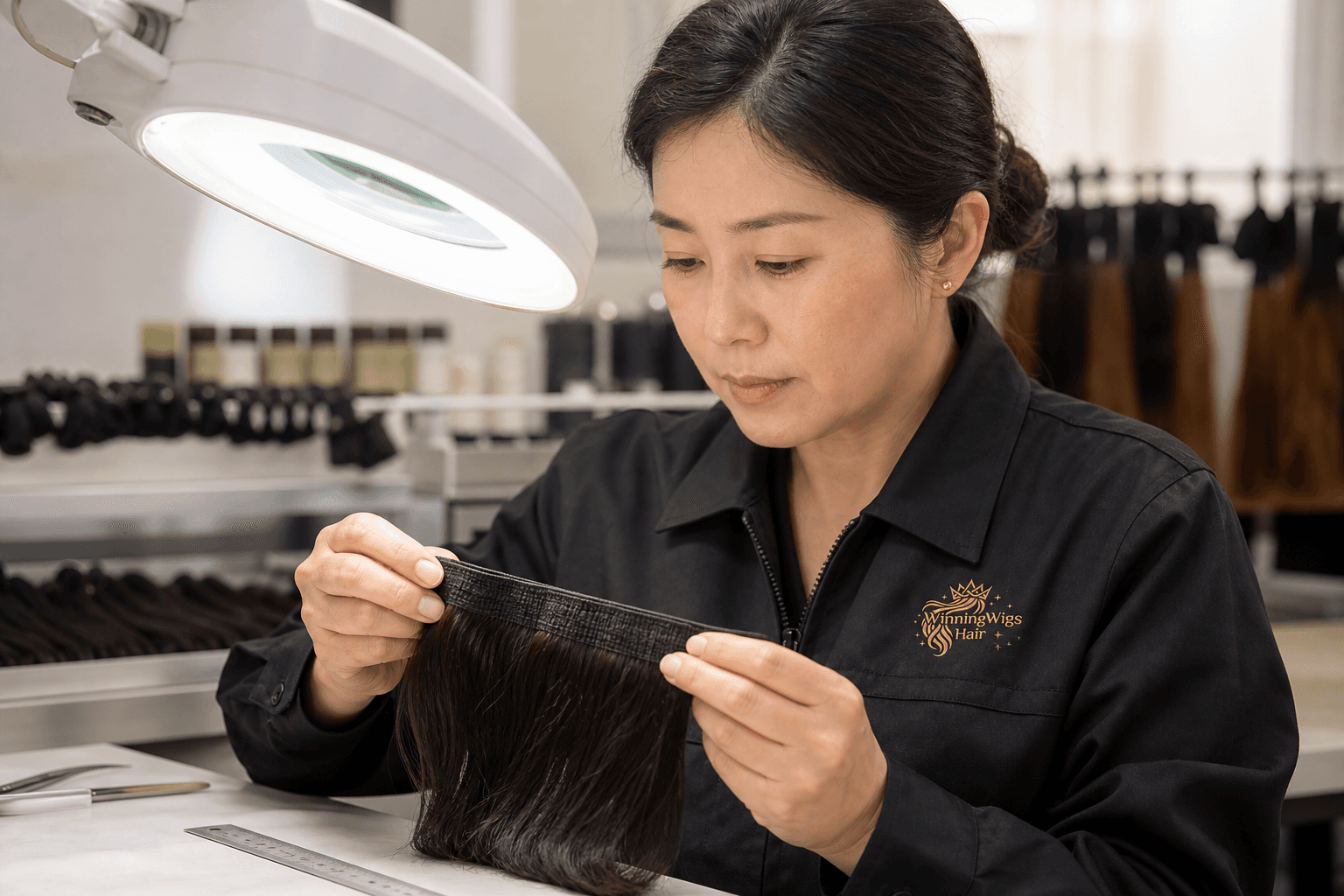
For colour concerns, compare under consistent lighting. For texture concerns, record whether the hair is dry, wet, styled or naturally dried. For attachment concerns, identify the exact construction and planned installation method. For a wig or topper, distinguish hair presentation from cap, lace, hairline or fixing-component questions.
Photos are evidence, not complete proof. A physical review may be needed when an image cannot show touch, combing resistance, internal construction or the full product condition. If the original sample or reference is unavailable, state that limitation clearly and agree how a revised version will be controlled.
Use return analysis when it is appropriate
For material concerns, a returned product can be useful because the buyer and supplier can review the same physical item. WinningWigs’ documented workflow states that customers can share photos and videos, and that affected goods can be arranged for return examination. The review considers the received product condition, relevant order reference, care history and possible hair-processing factors. It is a collaborative review, not an automatic conclusion that either the customer or factory is responsible.
Before arranging a return, clarify which pieces will be returned, how they will be identified, which evidence already exists, whether the item was washed or altered, and which specific question the review should answer. Preserve the item’s received condition after return. If a product needs to be washed or restyled for a controlled comparison, record that method separately from the initial condition.
The return review should produce a documented observation and next action. It should not be described as a laboratory test unless a defined laboratory method was actually used.
Turn findings into corrective action
An investigation should end with a practical next step. Possible outcomes include:
- No difference found against the available reference
- Need for clearer product, installation or care documentation
- Need for a revised sample
- Need for production-process or construction review
- Need for packaging or label clarification
- Need for a customer-specific solution discussion
- Need for a controlled repeat-order adjustment
The corrective action should be specific. “Improve quality” is not an actionable decision. “Use the approved colour reference for the next sample, retain the packaging version and confirm the attachment construction before production” gives both teams a step that can be checked.
For an internal process, retain the issue category, evidence, finding, action owner and follow-up point. If a similar concern appears later, the team can compare it with the original record rather than restarting from memory. This is how product experience becomes useful operational knowledge without turning a single case into a public performance promise.
Prevent repeat issues with version control
Many quality disputes become more difficult because the original product record is incomplete. For repeat orders, retain the original order number, approved sample version, product or SKU identifier, colour reference, texture reference, length, construction, packaging version, customer feedback and approved change history.
Treat a material change as a new version. A new shade direction, curl reference, cap construction, attachment type or pack configuration should not be assumed to be the same approved product. Clear version control helps a buyer distinguish a repeat order from a revised product-development request.
This approach also improves quotation comparisons. When suppliers receive different or incomplete descriptions, price differences may reflect different products rather than a meaningful quality comparison. A controlled brief makes the commercial discussion clearer before a new order begins.
Communicate findings without overpromising
A professional response should be prompt, calm and evidence-based. Useful language includes:
- “We are reviewing the product against the confirmed order reference.”
- “Please share photographs and details of when the concern appeared.”
- “We will keep the product condition and care history separate from the initial observation.”
- “The available information does not yet confirm one cause.”
- “We will discuss the findings and appropriate next step with you.”
Avoid unsupported statements such as “this can never happen,” “the customer must have used the wrong products,” or “all future orders will be perfect.” Trustworthiness is not about sounding certain. It is about explaining what is known, what needs review and what happens next.
Create a practical issue-review timeline
Speed matters, but speed should not remove the evidence. A simple timeline makes the review easier for both sides. First, acknowledge the report and request the product reference and available media. Next, preserve the initial condition and collect installation, washing, styling and storage information. Then compare the item with the approved reference, determine whether a returned product or additional evidence is needed, and document the agreed action.
Each stage should have a clear owner. A customer-service colleague may collect the initial order information, a product or quality colleague may compare the item with the sample reference, and the account owner may coordinate the response and next commercial decision. The same person can fulfil more than one role in a smaller team, but the handoff should still be visible.
This timeline protects customer relationships because it gives the buyer a clear expectation: the report is being reviewed, the evidence needed is known, and the next communication will be based on recorded findings. It also helps a supplier distinguish an isolated service question from a product-version issue that needs a broader corrective action.
Use issue data to improve product application guidance
An issue record can reveal where buyer guidance needs to be clearer. If several questions concern tape-in installation preparation, the next product sheet may need more explicit application boundaries. If colour feedback repeatedly refers to photographs, the team may need a stronger physical colour-reference process. If packaging creates warehouse confusion, the SKU and label information may need revision before the next order.
These are improvement opportunities, not conclusions about blame. Connect each change to the evidence that prompted it, update the relevant product or order version, and confirm the revised requirement before production. This is how a professional supplier turns customer feedback into a controlled learning loop while avoiding exaggerated claims about project results.
Decide when an issue needs escalation
Some reports can be clarified quickly with an order reference and additional photographs. Others need a broader review. Escalate when the available reference is missing, when the observation is repeated across multiple SKUs or orders, when the affected product needs to be returned for inspection, or when a potential safety, destination-market or business-continuity concern must be handled by the appropriate responsible team.
Escalation should not mean confrontation. It means the issue is important enough to require a clearer owner, additional evidence or a more formal decision. Record what is known, what has not been confirmed, which product versions are affected and when the next update will be given. A buyer can make better commercial decisions when this information is visible.
Where evidence does not support a conclusion, preserve that uncertainty. The right outcome may be a revised sample, a controlled trial, additional product documentation or an agreed shipment hold. Treating uncertainty honestly is more credible than selecting a simple explanation too early.
FAQ
Should a supplier decide the cause from photos alone?
Not always. Photos are useful evidence, but a complete review may need product identity, order records, care history and sometimes a return analysis.
Does a customer need to provide care history?
Care and installation information can help explain an observation. It should be collected neutrally, without assuming that the customer caused the issue.
Can one returned product prove an entire shipment has the same problem?
No. It may show a concern in that specific item. The wider scope should be established through records, comparison references and further inspection where appropriate.
What if the original sample or colour reference is unavailable?
Record that limitation. The supplier and buyer may need to agree on a new reference before approving a revised sample or repeat order.
How should a repeat order be protected after a quality concern?
Keep the original product record, document the issue and agreed action, then confirm any revised specification or sample before the next production run.
Conclusion
Human hair quality issues should be investigated with evidence, not assumptions. A clear product identity, preserved condition, neutral use-history review, reference comparison and documented next action create a fairer process for buyers and suppliers. This does not promise that every issue will have one simple cause. It creates a professional route from an observation to a useful next decision.
LET'S TALK ABOUT YOUR PROGRAM
Ready to turn product questions into a clearer brief?
Share your target customer, product category and requirements. Our team will help structure the next sample or quotation conversation.