
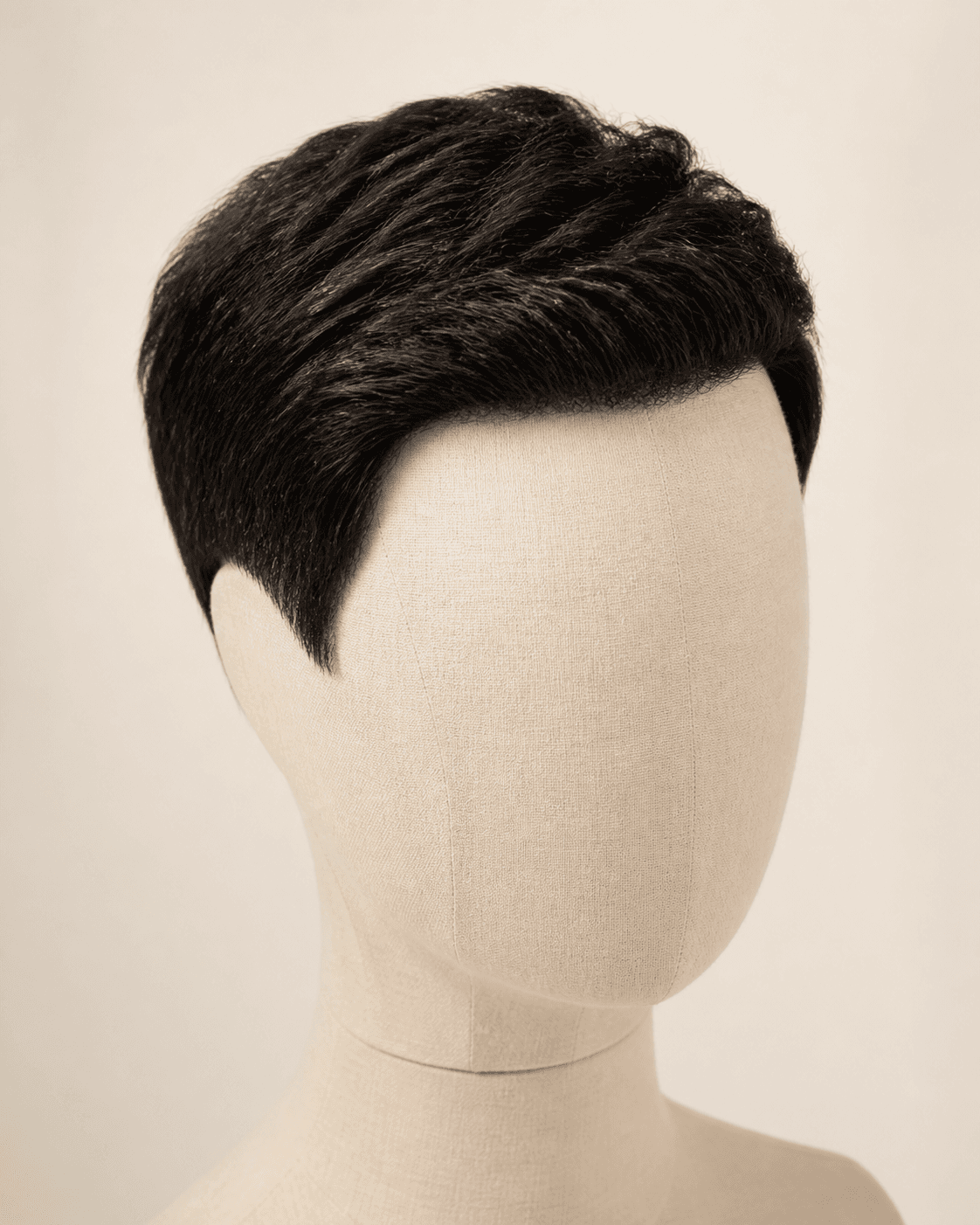
Men’s hair systems are not a single interchangeable product. A successful wholesale or salon program depends on matching base construction, hair direction, density, color, front contour and size to the client service model. The same buyer also needs a repeat-order process that helps a replacement system stay close to the approved reference.
For distributors, hair-replacement studios and salon groups, the goal is to build a specification that a men’s hair system supplier can understand and a professional can use. This guide explains the main decisions without claiming that one base or one density is right for every wearer.
Start with the service model
Before selecting a base, clarify how the program will be sold and serviced. Are systems cut and fitted in a studio? Are they shipped to trained partners? Is the priority an undetectable front, easy attachment, durability, a particular price range or a repeatable stock assortment?
The answer affects the specification. A stock program may need a concise range of base sizes, popular colors and a clear ordering code. A custom replacement program may need a client record covering contour, hair direction, density zones, grey percentage and base construction.
Understand the main base types
Base selection is often the first technical decision, because it influences appearance, attachment options, handling and replacement planning.
Lace bases
Lace is often considered where a natural-looking front and breathable feel are important. Fine lace can be visually discreet when it is correctly fitted and maintained. The buyer should ask which type of lace is being quoted, where it is used on the base, how the hair is attached and what handling guidance applies to the front edge.
Lace is not a blanket answer for every client. The service team should consider attachment method, lifestyle, scalp condition, cleaning routine and the desired replacement cycle. Product education should explain that delicate areas require careful handling.
Skin or poly bases
Skin or polyurethane areas are commonly considered for a smooth surface and tape or adhesive attachment. Thickness, edge design and coverage area should be specified rather than described only as “ultra-thin.” A buyer should confirm the base material, nominal thickness where the supplier provides it, front treatment and whether the base is full skin or part of a hybrid construction.
The operational question is how the system will be attached, cleaned and removed by the intended professional. A thin edge may be a visual benefit, but it also needs suitable handling expectations.
Monofilament bases
Monofilament areas can be selected when the program needs a more structured base and a particular appearance at the top or crown. Confirm whether the mono is used across the full base, in a defined panel or combined with lace and skin. The size, edge layout and hair direction should be documented in the SKU or client record.
Hybrid bases
Many B2B programs use a combination of materials: for example, a lace front with a skin perimeter or a mono area. Hybrid systems can match a specific service approach, but the specification needs to be more detailed. A simple product name is not enough; request a base diagram showing each material area.
Build a complete hair specification
Get a QuoteThe base is only one part of the system. A supplier needs a complete hair brief to prepare a meaningful sample or quotation.
Size, contour and coverage area
Confirm the base size in a consistent unit, the front contour and whether the system is intended to be trimmed. For custom programs, record the approved template or dimensions. For stock programs, use a simple size grid and make clear which dimensions are before trimming.
Hair length, density and graduation
Density is best treated as a visual target linked to the client profile, not a universal number. State the desired density range, whether the front should be graduated, and whether there are lighter or fuller zones. Ask the supplier how density is described in its product system and make sure the sample and repeat order use the same reference.
Length should include the measurement point and any intended cutting allowance. If a salon will cut the system into a final style, that should be stated in the buyer brief.
Hair direction and parting
Hair direction is often critical to a natural result. Specify freestyle, left part, right part, center part, forward or another agreed direction. For a recurring client program, store a photo reference and written description. Do not rely on a generic image name alone.
Color, grey and texture
Color names vary between suppliers. Use an approved color ring, physical swatch or a documented reference sample where possible. If grey percentage or blended colors are required, state the placement and the approved visual reference. Texture should also be described clearly: straight, body wave, loose wave or another agreed direction, along with how it will be assessed on the sample.
Use a base diagram and client record
A base diagram turns a complicated conversation into a repeatable order tool. It can show base material zones, front contour, dimensions, hair direction, density zones, color, grey percentage and attachment areas. For a stock program, the diagram becomes a product sheet. For a custom program, it becomes part of the client record.
Keep the record simple enough to be used by sales, production and the hair-replacement professional. A complicated document that no one updates is less useful than a clear one-page record.
Plan the sample, fitting and reorder process
The first sample should answer the questions that matter to your service program. Review it with the professional who will fit, cut or install the system. Confirm the base dimensions, contour, material layout, hair direction, density, color and attachment preparation before treating it as an approved reference.
Fitting preparation
Installation preparation should follow the service provider’s professional process. The product manufacturer can provide construction and handling information, but the fitting professional should assess the client’s individual needs. Avoid publishing medical or scalp-health claims unless you have qualified evidence and the necessary review.
Shipment inspection for hair systems
Before dispatch, a B2B buyer can ask the supplier to review product code, base size, material layout, hair color, density direction, packaging and order quantity. For a first or custom order, agreed photos or video can help the buyer compare the shipment with the approved reference. Agree on what will be shown before production starts.
Reorder discipline
A strong reorder system avoids relying on memory. Store the approved SKU or client code, base diagram, color reference, size, contour, direction, density notes, grey detail, packaging version and last approved sample. When a client asks for a change, create a new revision rather than overwriting the previous record.
Ask suppliers the questions that reveal operational fit
Get a Quote- Can you provide a base diagram for this exact construction?
- How are size, density, color and grey percentage recorded for repeat orders?
- What sample information is needed before development begins?
- What is checked during production and shipment inspection?
- Which attachment areas are compatible with the intended base design?
- How should the professional handle trimming, front-edge preparation and cleaning for this product?
- What packaging, labeling and care information can be developed for a private-label program?
These questions do not replace a professional fitting consultation, but they help a wholesale buyer compare factories on specification quality rather than on general marketing language.
Decide between a stock range and a custom program
A stock range and a custom replacement program solve different buying problems. A stock range helps a salon group or distributor serve common needs quickly. It may use a defined selection of sizes, base types, colors, lengths and contours. The trade-off is that the professional may need to trim, cut and personalize the final piece during fitting.
A custom program is more suitable when the business has a repeat client record and needs a closer match to a specific template, direction, grey blend or density pattern. The trade-off is more information gathering and a more disciplined approval process. A buyer should not describe a program as “fully custom” if the factory is only receiving a color choice and a standard base size.
Start with the service model and build the simplest program that meets it. A distributor with new hair-replacement partners may begin with a stock assortment plus a clear reorder code. A specialist clinic or studio may need a client-record workflow. The best option is the one the sales, fitting and purchasing teams can maintain consistently.
Create product codes that survive a repeat order
A useful code may combine base family, size, contour, color, grey percentage, density direction and length. The exact format can be short, but each element must have a stable definition. For example, a code should not use a color name that changes between teams, or a word such as “medium density” without a reference range.
The buyer can keep a customer-facing product name separate from the internal ordering code. This allows the sales story to remain simple while the production instruction stays precise.
Prepare partners to sell and fit the system responsibly
The product sheet should help a professional have an honest conversation with a client. It can explain the base materials, intended use, care routine, fitting preparation and when professional service is needed. It should not make medical claims or guarantee a specific lifespan, because replacement timing depends on construction, attachment method, maintenance, lifestyle and individual use.
For B2B partners, create a basic education pack alongside the product. It might include a base-type comparison, a terminology glossary, a blank client-record form, care-instruction template and photo guide for submitting a custom request. Every item should be reviewed against the actual supplier specification.
Use images as specification aids, not only decoration
Good images can make a hair-system brief easier to understand. Photograph the base from the inside and outside, show the front contour, show the measured size and show the hair direction in a neutral setup. A factory image can support trust, but it should not replace technical proof. If a photo is AI-generated or illustrative, do not present it as documentary evidence of a specific client, factory inspection or product test.
For a custom order, buyers can request a standardized photo set before shipment: full base, front edge, inside construction, color under neutral light, reference code and packaging. Agree on the photo process before production begins.
Make reorders easier for the customer service team
The reorder conversation should not start from zero. A service team can ask for the prior code, fitting date, required changes and current photos where the client permits them. The business should then decide whether the order is a repeat or a new revision.
Common change requests include a different grey percentage, a new hair direction, an altered density at the front, a different base size or a changed attachment preference. Each change should be written clearly, then approved against a new sample or revision process when the difference is material. A disciplined process protects both the supplier and the client from an order that is assumed to be the same but is not.
A first-order checklist for wholesale buyers
| Stage | Questions to close before moving on |
|---|---|
| Product brief | Have base, size, contour, color, hair direction, density and target service model been recorded? |
| Sample review | Has a trained fitter checked the product against the brief and documented feedback? |
| Packaging review | Are product code, care information and private-label components accurate and complete? |
| Production approval | Is there a signed or written reference that separates approved features from open choices? |
| Shipment inspection | Are quantity, construction, color, packaging and reference evidence aligned before dispatch? |
| Reorder setup | Can sales and customer service retrieve the approved code and revision history? |
This checklist gives a buyer a way to run a small pilot program before building a broader range. It also provides the raw material for authoritative future content: real, verified process notes rather than generic sales claims.
Compare quotations and factory answers with the same brief
A men’s hair-system quotation is only meaningful when suppliers are pricing the same base, size, contour, hair length, density direction, color and packaging expectation. A generic request for a “natural men’s toupee” leaves too much room for assumptions. It can produce quotations that look comparable but describe very different systems.
Give every supplier the same base diagram or written template. Ask them to identify any detail that is unavailable, uncertain or dependent on sample approval. The best reply is not the one that says yes to every request. It is the one that separates confirmed construction details from choices that still need a physical reference.
For a complete landed-cost decision, include the product cost, expected sample and revision work, packaging, freight terms and the internal service time needed for fitting or education. A lower unit price may not be the lower program cost if the product record, fitting guidance or repeat-order process creates avoidable rework.
Keep customer language separate from factory language
A retail or studio-facing product name should be simple. It may describe the intended benefit in honest, understandable terms. The factory-facing specification must be more precise: materials, dimensions, direction, density notes, color code, contour and packaging version.
Maintaining both levels helps a business sell with clarity while ordering with accuracy. It also makes website content more useful. Your public guide can explain what lace, skin, mono and hybrid bases are for; the private order record can contain the exact details that should not be guessed from a web page.
As your team gains verified experience, use recurring client questions to improve the guide. This gives AI search systems richer, specific answers and gives prospective partners evidence that the business understands the service workflow behind the product.
FAQ
Which base is best for a natural front hairline?
Lace is often considered for a visually discreet front, but the correct choice depends on the desired appearance, attachment method, service routine and client needs. Ask for the exact base diagram and sample before choosing.
Is a skin base better than a lace base?
Neither is universally better. Skin, lace, mono and hybrid designs offer different handling and appearance trade-offs. Select the base around the intended service model and approved sample.
What details are needed for a custom hair-system reorder?
Keep the product code, base size, contour, material layout, hair direction, density notes, color, grey percentage, texture, packaging version and approval reference. Record revisions separately.
Can a wholesale supplier prepare private-label packaging?
Many suppliers can discuss packaging options, but the buyer should provide final brand copy, market-specific labeling requirements and an approved packed sample before bulk production.
Conclusion
Men’s hair-system sourcing becomes more reliable when the buyer works from a complete specification rather than a product name. Base diagram, hair direction, density, color reference, sample approval and reorder records all help a supplier and service team work from the same expectations.
LET'S TALK ABOUT YOUR PROGRAM
Ready to turn product questions into a clearer brief?
Share your target customer, product category and requirements. Our team will help structure the next sample or quotation conversation.