

The best human hair wigs for white women combine a believable hairline, suitable density, a well-matched color and a cap that fits securely. There is no single construction, hair origin or blonde shade that works for everyone. The right choice depends on the appearance you want, how you wear your hair and how much maintenance you can manage.
Searches for “white women” or “Caucasian wigs” often express a practical concern: finding a wig that resembles the wearer's familiar hair rather than an unfamiliar volume, texture or hairline. Those search terms are useful starting points, but ethnicity does not determine head size, skin tone or hair texture. Turn the request into individual specifications.
This guide helps wearers compare options and gives salons and private-label buyers a framework for their customer requirements. WinningWigs supplies professional wig programs; the product examples below are construction references, not an independently tested brand ranking.
Which wig features matter most for a natural look?
Start with the features visible in the hairstyle you actually wear. An exposed forehead makes front-lace blending important. A center part draws attention to the top construction. A short bob exposes the perimeter differently from long waves.
| Your priority | A useful starting point | What to confirm |
|---|---|---|
| Hair worn away from the face | Lace front with a carefully finished hairline | Lace tone, front contour, knots and security |
| A visible center or side part | Lace top or a suitable monofilament area | Usable parting space and scalp appearance |
| Familiar fine-hair proportions | A restrained density and appropriate cut | Front, crown and end fullness on a sample |
| A rooted blonde or balayage finish | A dimensional color reference | Root depth, undertone and transition placement |
| Repeatable salon or retail stock | An approved sample and written specification | Cap measurements, shade record and reorder terms |
Human hair can offer styling flexibility, but it does not compensate for a poorly fitted cap or a mismatched hairline. Compare the finished wig as a complete product before judging it by a premium label.
Check the lace, hairline and parting together
Match the lace to the scalp area it will cover
Ask for close views of the front edge, temples and part in diffuse daylight. Place the actual lace against the wearer's skin during a fitting where possible. Pale, fair and light-medium complexions are not interchangeable; neither are transparent and tinted lace options.
“HD” describes a supplier's lace offering, not a guarantee that the edge disappears on every person. Ask about the actual material, tone, dimensions and handling instructions. Check whether the advertised parting area is entirely usable or interrupted by another cap section.
Separate a prepared hairline from a finished installation
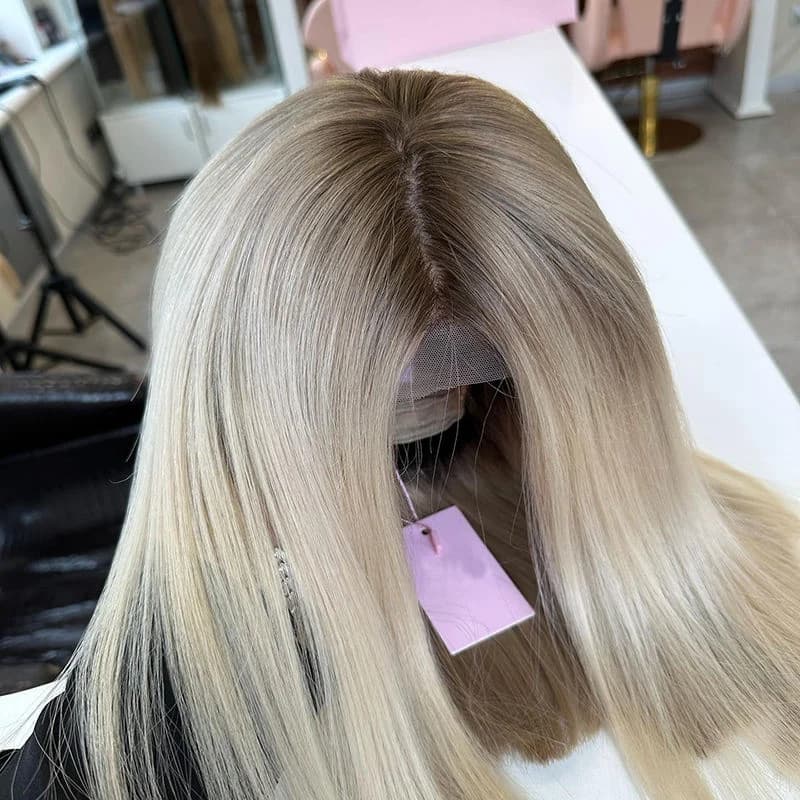
A natural result depends on the cap position, front contour, hair distribution and any necessary customization. Bleached knots can make dark knot dots less prominent, but the result needs inspecting on the actual shade. Additional bleaching or plucking should be assessed by a qualified wig professional rather than assumed necessary.
The lead photograph shows visible untrimmed front lace. This is a preparation stage, not a finished installation standard. Ask whether the delivered wig requires trimming, styling or other fitting work, and establish the return conditions before altering it.
Choose density by appearance, not a percentage alone
Compare the front, crown and ends separately
Low density human hair wigs can suit someone seeking the proportions of naturally fine hair. However, choosing the lowest available figure is not automatically better. Too little coverage can expose the base; excessive fullness can make the crown or hairline look unfamiliar.
Density labels such as 130%, 150% and 180% should be interpreted within the supplier's own range. They are not a universal measurement that makes different brands directly equivalent. Ask for a physical reference and compare similar lengths, textures and cap sizes.
Also distinguish density from end fullness. “Double drawn” concerns the distribution of hair lengths and the appearance of the ends; it does not describe the cap or guarantee a lightly ventilated hairline. A fuller perimeter and a softer front can be separate requirements.
Consider how the cap creates volume
Construction and styling influence perceived fullness. Jon Renau's density explanation illustrates how hair attachment and cap design can change the apparent volume of wigs with similar hair weight. Use that principle when comparing samples, rather than treating weight or a density label as the whole answer. Our low-density wig guide explains how to balance front, crown and rear coverage when requesting less bulk.
Match color, roots and texture to the intended wearer
For a blonde wig, specify more than “ash blonde” or “natural blonde.” Compare the base level, warm or cool direction, root shade, root length and placement of lighter sections. A darker root may suit one brief and create an unwanted contrast in another.
Use a physical swatch or approved sample when possible. Request daylight and neutral indoor photographs without beauty filters. A phone screen, salon lighting and camera white balance can each change the apparent tone, so do not approve a repeat-order color from a single edited photograph.
Texture matters just as much. Compare the hair after the supplier's recommended wash and styling routine, not only after a showroom blowout. Ask whether the photographed waves are a temporary styled finish or the supplied texture. Never infer donor origin, processing history or fiber composition from a blonde color or a silky photograph.
Compare cap construction and measure the fit
Understand what each construction actually provides
| Construction | Useful application | Buying consideration |
|---|---|---|
| Lace front | Hairstyles exposing the front hairline | The remaining cap may be wefted or use another construction |
| Lace top | Styles needing a defined top parting area | Confirm the panel dimensions and actual parting limits |
| Full lace | More extensive parting and styling options | Check perimeter construction and support for the planned style |
| Monofilament area | A scalp-like appearance in a specified zone | A mono part, crown and full top offer different coverage |
These features can be combined. A lace-front wig may also have a monofilament top or a hand-tied back. Ask for an inside-out cap photograph and a diagram rather than assuming the product name describes every section.
Take measurements before choosing a size
Record circumference, front-to-back and ear-to-ear measurements using the supplier's method. Explain whether the wig will be worn over existing hair and which liner or grip is intended. Compare all relevant dimensions with the selected cap, rather than relying only on “petite” or “average.”
The American Cancer Society's wig guide also emphasizes checking the brand's sizing and allowing for fit changes with hair loss. For treatment-related hair loss or a sensitive scalp, involve an experienced fitter and follow the care team's guidance where relevant.
During a trial fitting, check the ear tabs, nape, glasses and gentle head movement. A secure cap should not require excessive tightening. “Glueless” describes an attachment approach; it does not prove that a particular cap fits every head.
Evaluate hair quality and the complete purchase cost
Separate material, processing and origin claims
Request a written description of the hair fibers, coloring, texture processing and any claimed origin. Human hair, Remy and virgin address different questions. Ask how the supplier uses each term for the finished colored product, particularly when a quotation describes a very light blonde shade.
“European-style” can describe an intended appearance; it is not evidence of European donor origin. If a particular origin is essential, ask what traceability supports that claim. A visually convincing wig does not require the wearer and donor to share an ethnicity.
Check the sample for combing response, tangling, visible shedding, end condition and cap finish. A wash observation can inform a buying decision, but it cannot independently establish composition, ethical sourcing or a guaranteed service life.
Compare equivalent offers
Include the wig, fitting, cut customization, care supplies, delivery and any destination charges in the budget. Confirm whether lace trimming, knot work, styling and packaging are included. Ask about returns before paying, since custom work or alterations may affect eligibility.
There is no reliable universal price for the “best” wig. Two quotations may describe different cap areas, hair processing, color work or service support. For business buyers, compare the same specification and retain the accepted version beside the quote.
WinningWigs options to discuss for different requirements
For a defined lace top and fuller ends
The Double Drawn Hair HD Lace Top Wig is a reference for buyers comparing lace-top construction and end fullness. Published options include 8–30-inch lengths and 130%, 150%, 180% or custom density. Ask to see the selected combination; these options are not specifications for the photographs in this article.
For a hairline-focused brief
The Invisible Hairline Wig provides another construction reference, with an HD lace top and a bleached-knot option. Its published length range is 12–28 inches. Approve the actual front, temples, lace tone and density before translating the name into customer-facing claims.
For a specific color, cap or collection
Use the Custom Wig program when a stock reference does not meet the brief. WinningWigs' published wig minimum is one piece per color and length combination. Confirm the sample arrangement, price and available customization for the exact design.
Published HD lace-top dispatch estimates are typically 1–4 working days for available semi-finished stock and 12–40 working days for custom orders, depending on complexity. Invisible Hairline custom dispatch is typically 40 working days from the order date. Confirm availability and scope; dispatch excludes transit and customs time.
Approve a sample before committing to a larger order
At WinningWigs, our published quality process includes visible-condition review, combing, curl-consistency checks and color comparison under standard inspection lighting. These are practical production checks, not proof that every pictured wig has completed a particular laboratory or wear test.
For your project, agree what factory testing should cover before sample approval:
- Label the sample with its cap, color, length and production reference.
- Photograph the front, part, interior and ends before further work.
- Check measurements, fit and the intended product application.
- Follow the supplied care routine and record the conditions and observations.
- Document any revision and retain the accepted sample for comparison.
Turn a style reference into an approval brief
Consider an illustrative salon brief for a client who wants a rooted blonde bob with a visible center part and modest volume. This is a planning example, not a reported customer outcome. The salon would first confirm the cap measurements and desired parting space, then compare the front density and root tone with a physical reference.
If the sample looks too full, identify where: the front, crown, sides or perimeter. Request a revised distribution or cut assessment instead of simply reducing every area. If the part looks too dark, compare the lace, knot appearance and liner before assuming the blonde hair color is wrong.
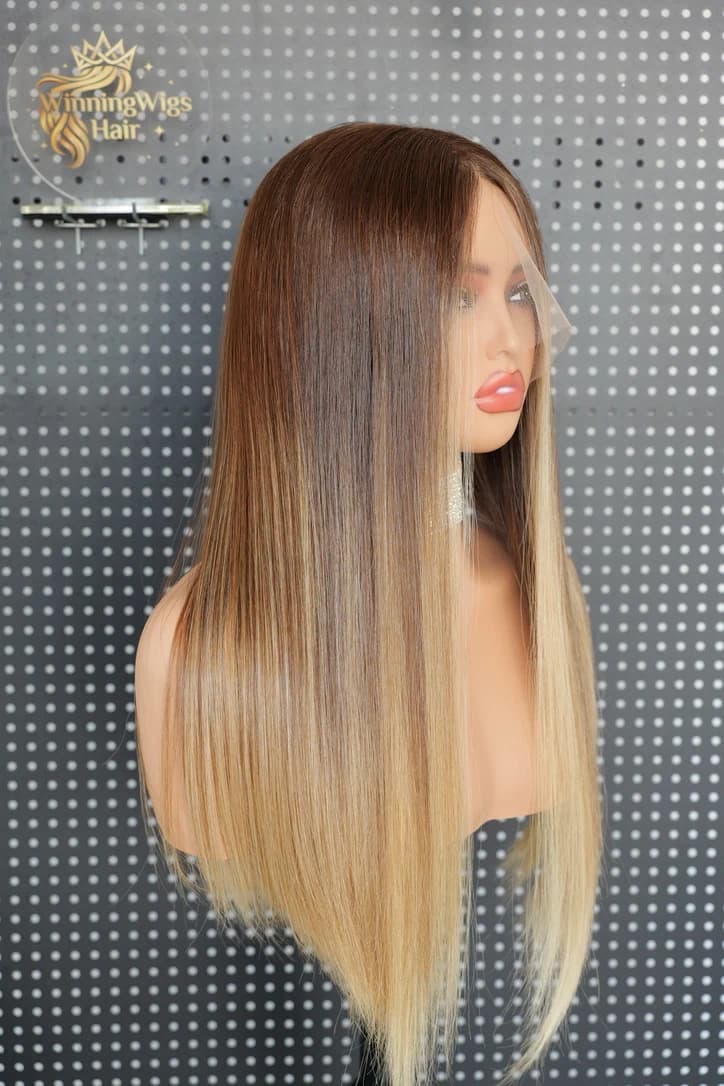
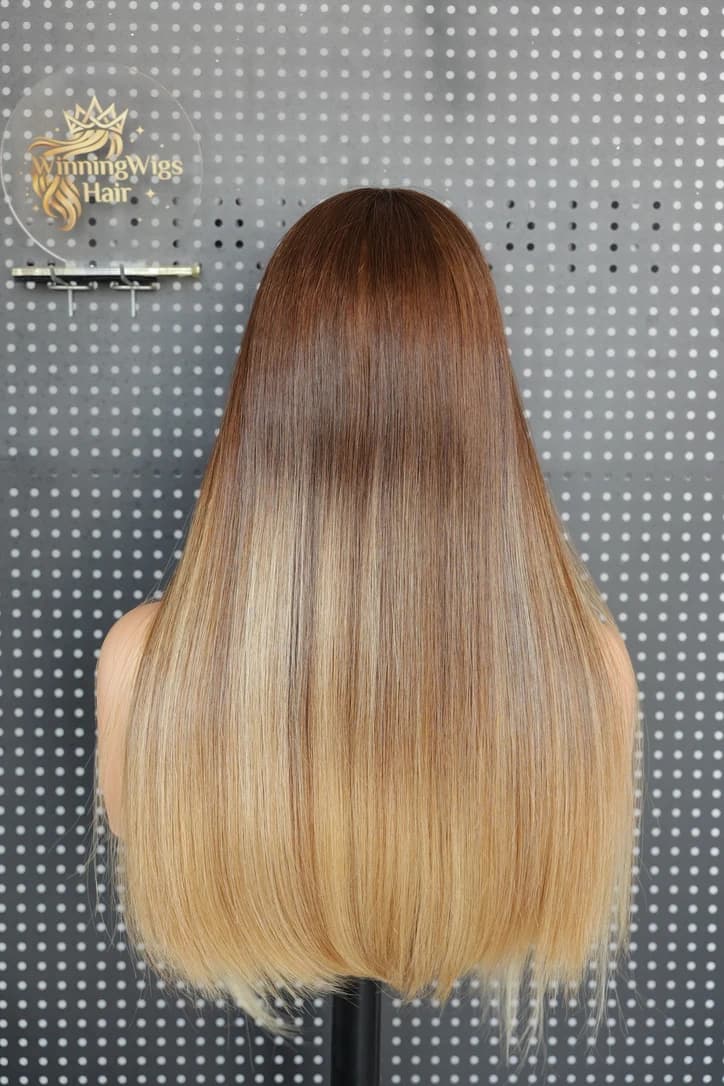
Record the approved changes in words and photographs. A note such as “keep the accepted cap and end fullness; soften the front distribution to match reference B” gives production a more usable instruction than “make it more natural.” Recheck the revised sample before approving a larger assortment. The same approach works for the longer brown-to-blonde style shown below, where transition placement and rear coverage deserve their own approval views.
For shipment inspection, compare product codes, cap details, shades, quantities and packaging with the approved order. Resolve substitutions before dispatch. On arrival, document discrepancies before mixing inventory, trimming lace or carrying out additional processing. Our sample evaluation checklist can help structure the records.
Plan installation preparation and daily care
Check the fit and intended attachment method before cutting lace. A wig professional can assess the front contour, parting and cut while the wearer is present. Avoid aggressive thinning or further chemical processing simply because a tutorial recommends it for a different product.
Follow the instructions supplied for the finished wig. Detangle gently, support delicate lace, avoid rubbing the hair together during washing and dry the cap appropriately before storage. Jon Renau's human-hair care guidance explains why careful handling and keeping conditioning products away from hand-tied bases matter. Use the selected wig's own heat and product guidance rather than applying another manufacturer's settings automatically.
Agree who will provide maintenance support. For a salon range, the care card should match the actual construction and processing, with a clear route for reporting tangling, fit or lace concerns.
FAQ
What are the best human hair wigs for white women?
The best choice matches the individual wearer: a suitable cap size, believable front and part, appropriate density, and a compatible shade and texture. Compare actual samples and service support rather than choosing solely by ethnicity-focused marketing or a premium hair label.
Are low density wigs always more natural?
No. They can suit a fine-hair appearance, but coverage, cap design, length and cut also matter. Approve the front, crown and ends separately. A density percentage from one supplier is not automatically equivalent to the same percentage elsewhere.
Is lace front or lace top better?
They address different areas and may be combined. Lace front concerns the front hairline; lace top concerns the top panel and parting. Choose around the hairstyle, then confirm the actual construction with interior photographs and a fitting.
Do I need European hair for a natural result?
No. Evaluate the finished texture, color, density, cap and hairline. If donor origin is part of the purchasing brief, request supporting traceability. The terms “European-style” and “European-origin” should not be treated as interchangeable.
Can human hair wigs be colored or heat styled?
Possibilities depend on the finished hair, previous processing and cap construction. Obtain product-specific instructions and have a qualified professional assess proposed changes. A human-hair description does not promise unrestricted bleaching, coloring or heat exposure.
How long will a human hair wig last?
There is no single lifespan for every wig. Wear frequency, processing, friction, care and cap handling all affect condition. Request realistic maintenance guidance and distinguish a sample observation from a warranty or replacement commitment.
Conclusion
Choose the best human hair wig by defining the result you want and checking the details that create it. Start with fit, hairline, parting, density and color; then assess the sample, service requirements and purchase terms. A clear specification is more useful than a universal “best” claim.
For salons and brands serving white women, record individual preferences rather than assuming one cap or blonde shade fits the whole audience. That record supports fitting, sample approval and more consistent reorders.
LET'S TALK ABOUT YOUR PROGRAM
Ready to turn product questions into a clearer brief?
Share your target customer, product category and requirements. Our team will help structure the next sample or quotation conversation.