
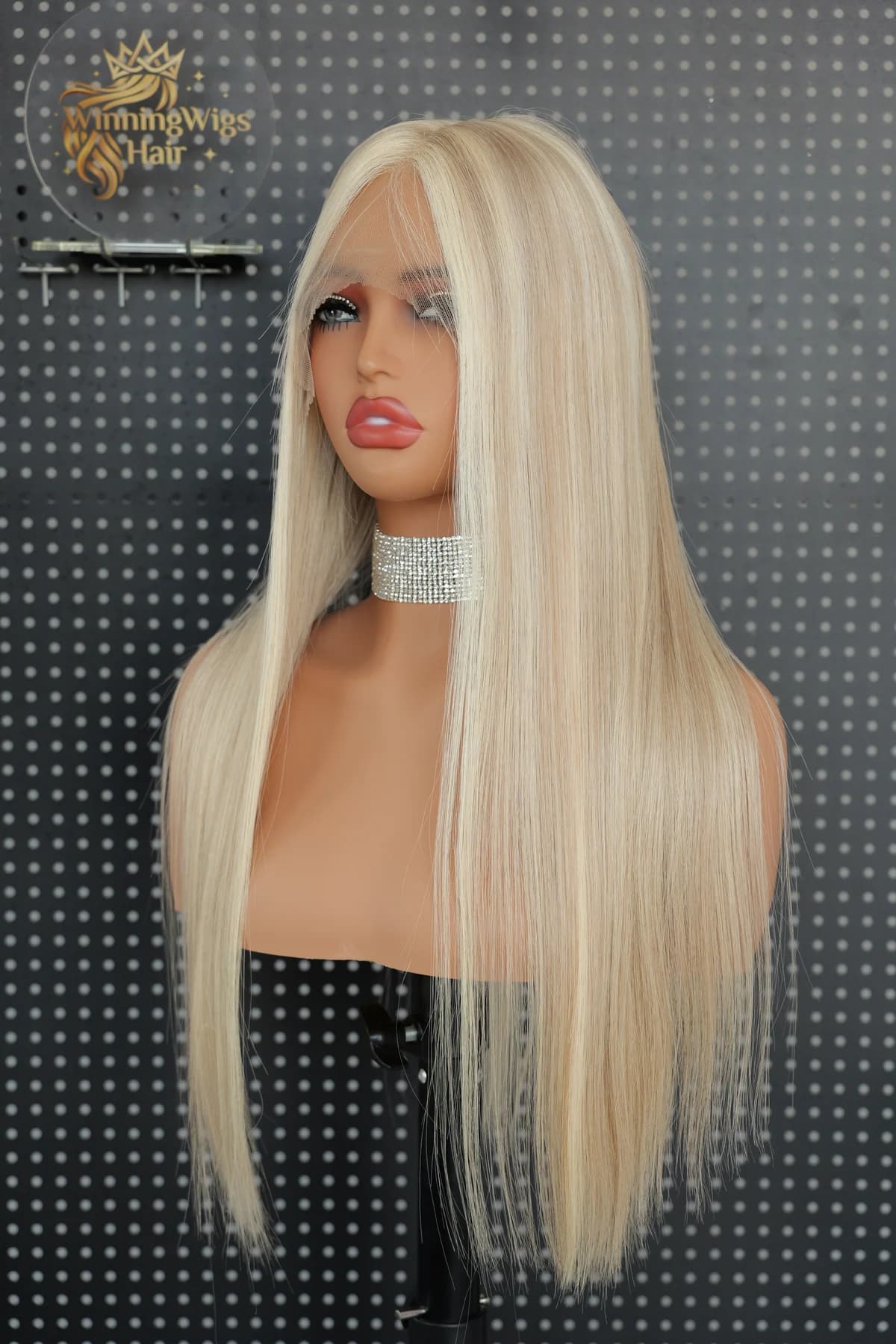
Choose a blonde human hair wig by approving three things together: the color distribution, the complete cap and the finished hair specification. A shade name such as champagne, platinum or ash is a starting point. The root, face frame, lace, length and density determine whether that reference meets the wearer's expectations and your purchasing brief.
For salons and private-label brands, a useful decision produces a repeatable specification. Compare an actual sample, record the accepted details and keep that reference with the quotation. WinningWigs' blonde human hair wig selection connects existing product photographs with their relevant construction and custom-order pages.
This guide explains how to select a shade, assess the cap and prepare a sample request. The photographs are real product references, including examples shown before lace trimming. They are not independent wear tests, color measurements or promises of an identical result on every wearer.
Start with the intended wearer and hairstyle
Describe the appearance the customer wants before discussing a color number. Ask whether the goal is to resemble familiar hair, try a brighter shade or develop a salon range with several color directions. Record the intended part, exposed hairline, cut and everyday styling routine.
Bring the color reference into the actual fitting conversation. A blonde wig worn behind the ears exposes different areas from a fringe or a face-framing bob. A long straight style presents color differently from waves. Compare the wig in the position in which it will be worn, with any planned liner or grip.
For a business assortment, separate the initial sample from the eventual stock plan. One approved shade on one cap does not automatically approve the same color on another construction, length or texture. Keep each combination identifiable so the purchasing team and supplier review the same product.
Describe blonde by tone, lightness and distribution
Use color names as directions
Champagne, beige, ash and platinum can help organize a discussion, but suppliers may use these labels differently. Ask what the name means for the selected product and compare a physical swatch or approved wig wherever possible. Evaluate the lightness and the desired warm, neutral or cool direction separately.
| Color direction | What to describe | What to confirm on the sample |
|---|---|---|
| Champagne or beige blonde | Desired balance of warmer and cooler-looking sections | Overall finish, roots and face frame |
| Ash blonde | The intended cool direction and depth | Appearance under agreed lighting and any darker areas |
| Platinum blonde | The requested light appearance | Exact shade reference, finished hair condition and cap details |
| Rooted blonde | Root depth, tone and extent | Transition at the part, front and temples |
| Brown-to-blonde | Darker base and placement of lighter lengths | Front, side and rear color distribution |
| Balayage highlights | Where light and dark sections should appear | Highlight placement and the retained base color |
Do not assume a shade name establishes a numbered code. Jon Renau's salon color conversion chart illustrates a manufacturer-specific system that distinguishes colors, blends and shaded roots. Use another brand's chart as an explanation of how a system works, not as an automatic conversion to WinningWigs' production references.
Compare photographs under consistent conditions
Request front, side, part and back views in consistent lighting, without beauty filters. Keep the background and camera settings as consistent as practical when comparing revisions. A phone screen and a strongly lit salon mirror can produce different impressions of the same hair.
Photographs are useful for placement and communication; a physical reference remains valuable for approval. Identify which image or swatch controls the order. If two references disagree, resolve that difference before sampling instead of leaving production to choose between them.
Specify roots and highlights separately
A darker root needs its own brief
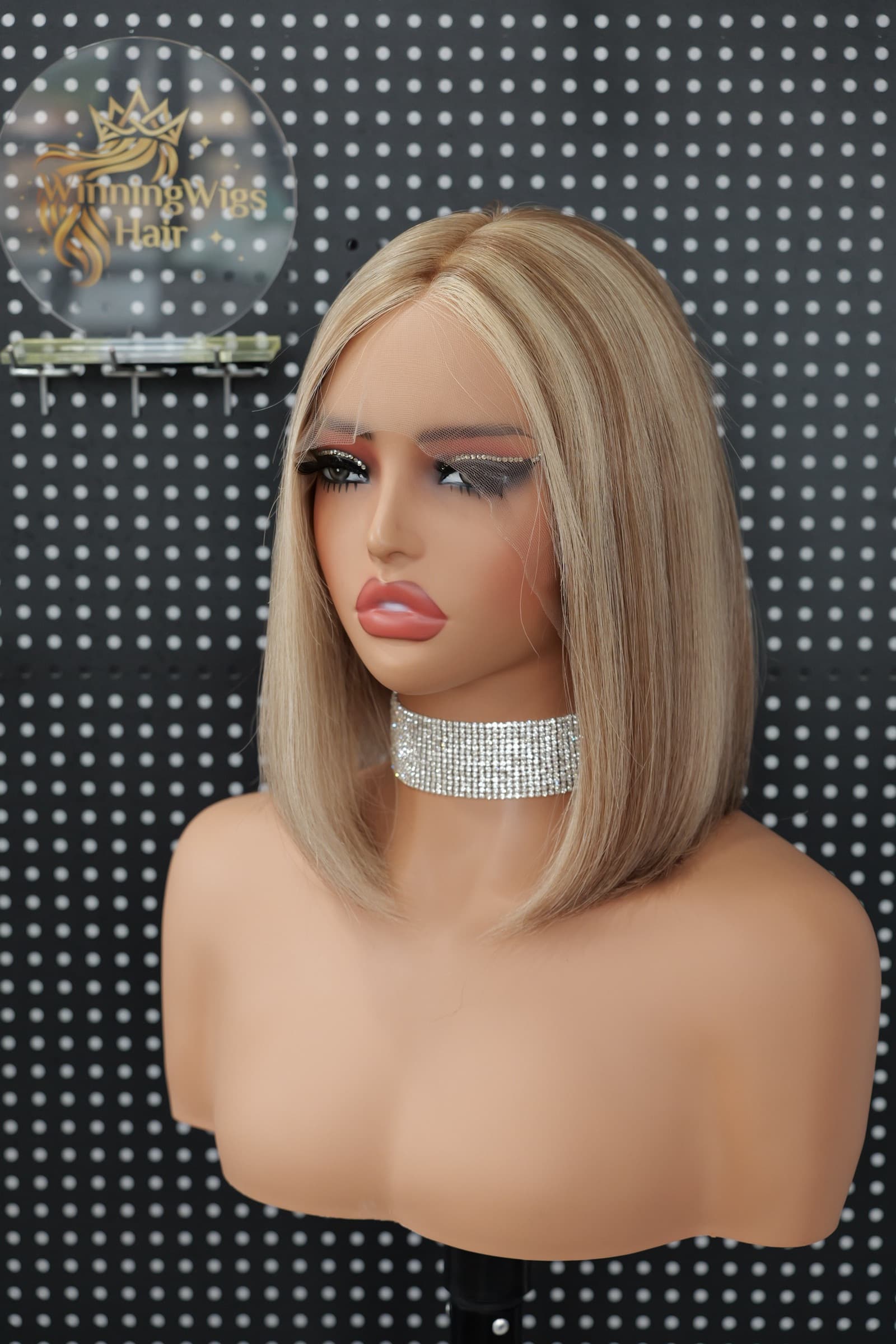
For a rooted blonde wig, describe the root shade, depth and transition using a marked reference. Show where the darker area should begin and end at the part and around the front. A root that suits a center part may create a different impression when the hairstyle is moved away from the face.
There is no universal root length that makes every blonde wig look natural. Compare the desired contrast with the wearer's preferences, the hairline finish and the planned style. Record the accepted distribution in photographs as well as words.
Distinguish an overall blonde from a brown-base design
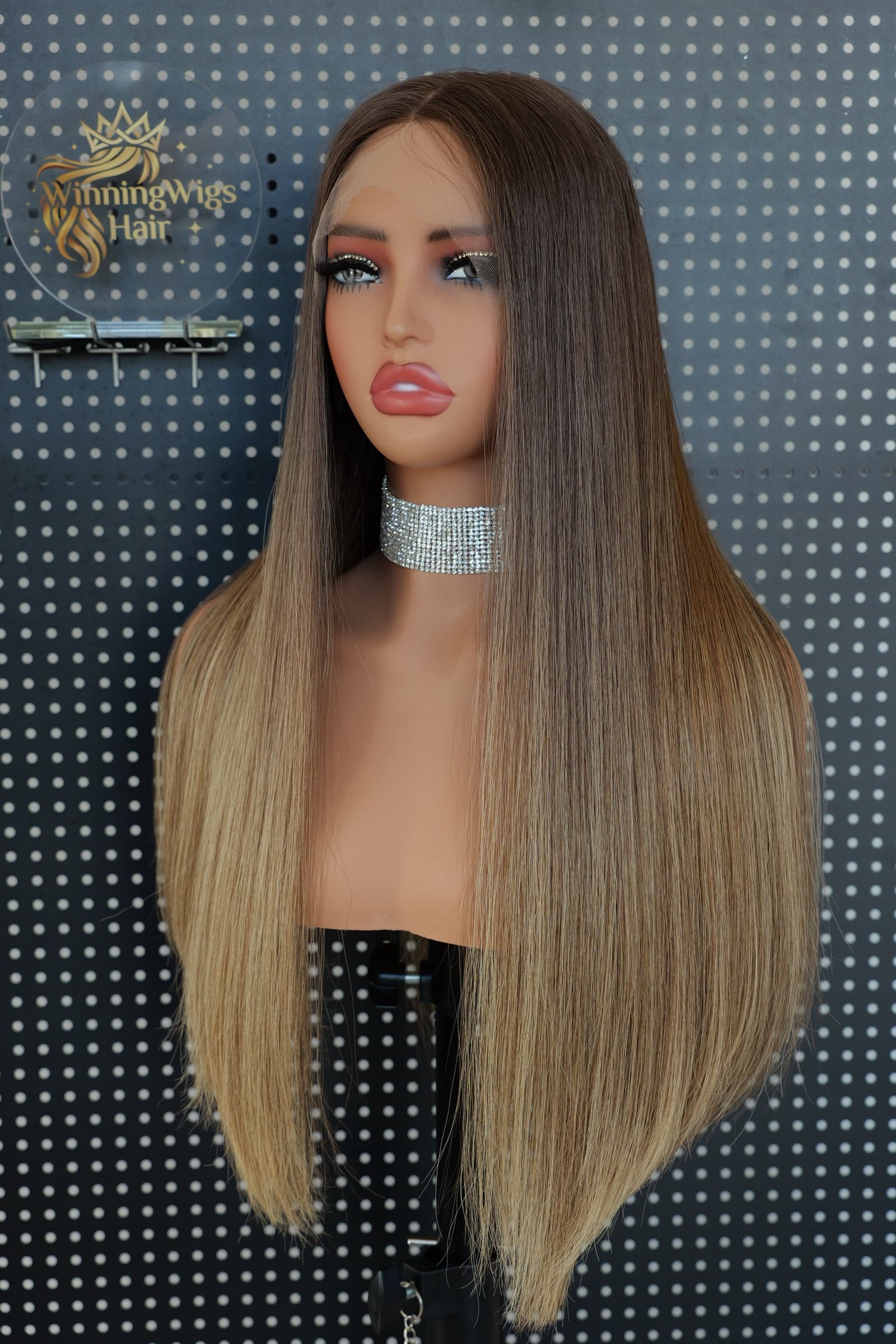
A predominantly blonde reference and a brown wig with blonde highlights are different purchasing briefs. A brown-to-blonde transition may retain substantial darker coverage at the top and sides. Balayage refers to a color-placement direction; it does not identify one cap construction or fixed proportion of blonde hair.
Ask to see the back and the underside of the lengths as well as the face frame. A bright front photograph may not show how much brown remains elsewhere. Specify the approved placement when ordering a longer length, since a changed cut can alter where the color transition appears.
Choose cap construction independently of color
The blonde color does not establish how a wig fits, parts or attaches. Review the entire cap: front, top, sides, back, adjustment and supported attachment. Ask for inside-out photographs and measurements using the selected product's method.
| Construction reference | Useful question | Sample detail to inspect |
|---|---|---|
| Lace top | How much usable parting space does the design provide? | Panel dimensions, knots and complete cap layout |
| Hairline-focused lace design | What finish is specified at the exposed front? | Lace tone, front contour, temples and preparation |
| Full lace | Does the complete construction support the intended style? | Perimeter, reinforcement and fitting requirements |
| Headband wig | Does the customer want a headband-based front appearance? | Headband, internal adjustment and cap fit |
Measure the wearer rather than relying only on an average-size label. Explain whether existing hair, a liner or another accessory will be under the cap. Compare circumference with any other dimensions required for that design. A secure fit should be assessed without excessive tightening.
Lace should be compared against the area it will cover. Pale blonde hair does not mean every wearer needs the same lace tone. Likewise, a headband reference should be assessed as a headband construction, with its own fitting requirements, rather than treated as a lace-front equivalent.
Review density, length and the visible hairline
A color match can still look unfamiliar if the front, crown or ends are much fuller than intended. Evaluate those areas separately. A density percentage is meaningful within a supplier's range, but it is not a universal comparison between every manufacturer.
Length and texture also change the silhouette. Compare samples with similar cap dimensions, cuts and styling when evaluating a density revision. Double drawn hair describes the distribution of hair lengths and end fullness; it does not establish a lightly ventilated front or a specific cap design.
Check the sample with the planned part and hairline placement before trimming lace or removing hair. Ask which preparation steps are included in the delivered product. Further knot work, thinning or cutting should be discussed for that particular wig and assessed by an appropriate professional.
Compare the finished hair specification and care requirements
Separate material terminology from the finished shade
Ask how the supplier describes the hair in the actual product being quoted. Human hair, Remy, virgin and any origin statement address different parts of a specification. The chosen blonde coloring and texture processing should be confirmed separately, particularly when a very light shade is involved.
Do not assume every length within a named style uses the same hair option. The Vanilla Champagne Blonde lace wig, for example, lists Remy hair for 18-, 20- and 22-inch options and virgin hair for the photographed 24-inch option. Confirm the selected combination when comparing quotations.
Check the supplied care routine before approving a sample
Request care instructions for the finished shade and construction. Ask which cleansing, conditioning and styling products are supported, and whether any further color work is permitted. Human hair does not make every salon chemical or heat setting appropriate for every wig.
Jon Renau's human-hair care guidance recommends gentle detangling and keeping conditioner away from the cap because it may weaken knots. Apply that handling principle alongside the selected wig's own instructions. Another manufacturer's product list or settings should not automatically become the care specification for a different wig.
Ask the supplier before introducing toning products. Record the product and method approved for the sample, and assess the result before expanding the routine. The aim is a documented maintenance plan rather than an improvised color correction after delivery. Our human hair wig care guide explains the wider washing, drying and storage sequence.
Use existing WinningWigs references to narrow the shortlist
The blonde wig selection page separates blonde references from brown-base dimensional designs. It provides a practical starting point for a conversation about construction, color and sample approval.
Champagne blonde with a named finished style
The Vanilla Champagne Blonde style is photographed in a straight, natural-density finish with a 9 × 5-inch transparent lace area. Its listed length choices are 18–24 inches. Review the cap measurements, material by length and current availability on the product page before placing a sample order.
Platinum and beige references within a lace-top program
The HD Lace Top Wig program includes platinum and beige blonde photographs, with both longer and bob references in its gallery. Those images show color and style directions. Approve the exact cap, length, density and shade for the requested combination instead of assigning every published program option to a photograph.
Ash blonde and dimensional color
The Custom Wig program includes an ash blonde long straight reference for a custom discussion. The Invisible Hairline Wig shows a brown-to-blonde direction. The 24-inch balayage headband wig is a customer custom-order reference with a brown base and blonde highlights; request a quotation for a similar design.
Build a sample approval record before production
A useful sample record identifies what was received, how it was assessed and which version was accepted. Agree any factory testing and acceptance criteria before the sample is evaluated. Photographs alone do not demonstrate a completed wash test, wear trial or independently verified hair origin.
- Label the sample with its product, cap, shade, length and order reference.
- Photograph the front, part, sides, back, interior and ends before alteration.
- Compare cap measurements, shade distribution, hairline and visible finish with the written brief.
- Follow the supplied care method when checking handling, combing and any agreed wash observation.
- Record revisions clearly and retain the accepted sample for repeat-order comparison.
For an illustrative salon brief, imagine a customer requesting a cooler blonde bob with a visible center part and modest front volume. The salon would first approve the shade reference and root distribution, then compare the part, lace and cap dimensions. This is a planning example, not a reported customer result.
If the sample appears too warm, identify the affected area and compare it under the agreed lighting. If it appears too full, identify whether that concern is at the front, crown, sides or ends. A request to change both color and density should record each revision separately so the next sample can be assessed meaningfully.
For shipment inspection, match product identification, shades, quantities, cap details and packaging with the accepted order. Document discrepancies before mixing inventory, trimming lace or carrying out additional processing. Our B2B sample evaluation checklist can help organize these records.
Confirm the complete quotation and dispatch schedule
Compare equivalent specifications, including the hair option, cap, color work, length, density, preparation and packaging. Ask which fitting, cutting or care services your business needs to arrange separately. Include shipping and any applicable destination charges in the purchasing budget.
WinningWigs' published wig MOQ is 1 piece per color and length combination. HD lace-top semi-finished stock typically dispatches in 1–4 working days, subject to availability; custom HD lace-top orders typically dispatch in 12–40 working days, depending on complexity. Invisible Hairline custom dispatch is typically 40 working days from the order date.
These are construction-specific dispatch references. Confirm availability and timing for the finished style and shade in your quotation. Dispatch is separate from transit and customs. A custom color photograph is not evidence of immediate stock, and one approved sample does not reserve a future production slot.
FAQ
What is the best blonde human hair wig shade?
The suitable shade matches the wearer's preferred lightness, tone and color distribution. Compare a swatch or actual sample with the intended hairstyle and lighting. A shade name alone cannot determine the result for every person.
Does a blonde wig require a different cap size?
Color does not determine cap size. Record the wearer's measurements using the selected product's method, including any planned liner or existing hair beneath the cap. Confirm the complete fit rather than transferring a size label between brands or constructions.
Is a platinum blonde wig always color 613?
No. A platinum description or photograph does not establish a particular supplier code. Ask for the actual color reference and approve the sample rather than treating names and numbers as universal equivalents.
Are rooted blonde wigs always more natural-looking?
No. A darker root may suit one customer's preferred appearance and create unwanted contrast for another. Assess root depth, transition and placement with the planned part and front hairline.
Can I recolor a blonde human hair wig?
Confirm the supplier's instructions and alteration terms for that finished product before any further color work. Have a qualified professional assess feasibility on a suitable sample. Human hair and a light shade do not guarantee a predictable processing result.
Can a wholesale buyer order one sample?
WinningWigs' published wig minimum is 1 piece per color and length combination. Confirm sample pricing, the selected construction, customization, shade and delivery arrangements before ordering.
Conclusion
Choose a blonde human hair wig by connecting shade approval with roots, highlights, cap construction, fit and the finished hair specification. Evaluate the actual sample and retain a clear reference for the next order. This approach supports a more useful buying decision than selecting by a blonde label or an isolated photograph.
LET'S TALK ABOUT YOUR PROGRAM
Ready to turn product questions into a clearer brief?
Share your target customer, product category and requirements. Our team will help structure the next sample or quotation conversation.