
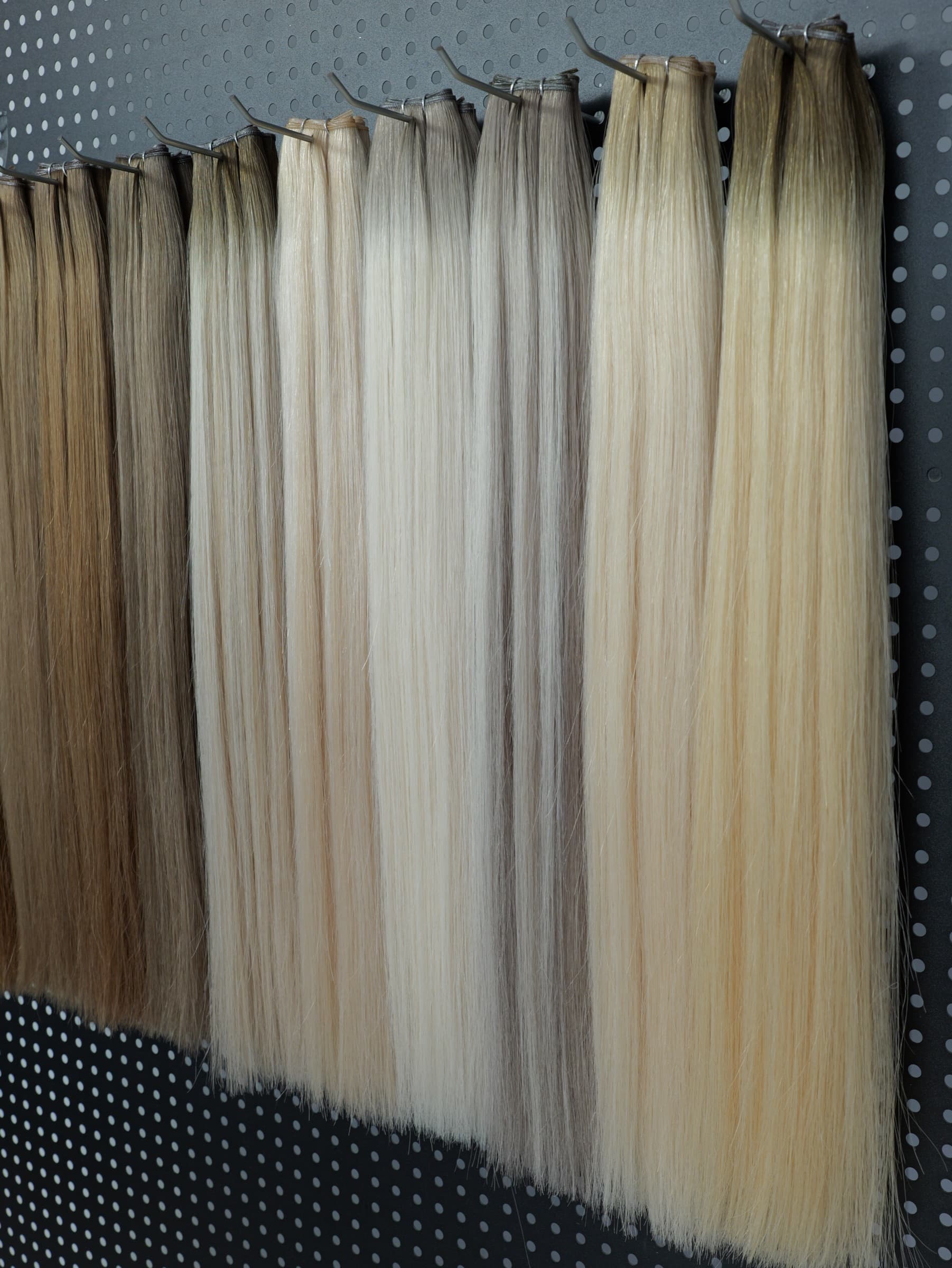
Introduction: there is no universally invisible method
What are the most natural-looking hair extensions? The most credible answer is not a single brand or attachment type. It is the product and application that match the wearer's natural colour, texture, strand character and density, while keeping the attachment out of sight in the hairstyles they actually wear. A beautifully made extension can look obvious if the shade is flat against dimensional natural hair, the added length has a blunt transition, or a row becomes visible when the client moves.
For occasional wear, a well-matched, correctly placed clip-in set may deliver the most convincing result. For a professionally maintained service, a suitably placed tape-in, low-profile weft or individual attachment can also blend well. None is automatically discreet on every head. The client's existing hair, desired look, installation skill and maintenance plan decide more than the marketing label “invisible.”
This guide covers product comparison, professional consultation and B2B sample review. WinningWigs supplies hair products; a qualified local installer assesses and performs professional application.
Quick answer: judge the blend, not just the attachment
A natural-looking result passes five checks: colour relates to roots, mid-lengths and ends; texture and movement resemble the client's hair; added hair suits the starting density; attachments remain discreet in usual hairstyles; and cutting and maintenance preserve the blend.
“Human hair,” “seamless” and “premium” are not sufficient answers on their own. Ask for the construction, shade, length, pack contents and handling instructions, then assess the proposed result on the client.
Compare methods by how they may become visible
Different methods hide in different ways. A thin attachment may reduce bulk, but it does not remove the need for enough natural hair to conceal it. The following comparison is a consultation framework, not a ranking or a suitability diagnosis.
Clip-ins, including PU-backed sets
These can provide removable volume or length when the pieces sit beneath adequate natural hair. Clips, a broad seam or an abrupt length change may show in thin sections or high styles. Check piece widths, clip positions, shade and whether a stylist should blend the cut.
Tape-ins, including low-profile formats
Flat tabs can blend when professional placement fits the intended sectioning. Exposed edges, poor spacing, colour mismatch or growth between visits can reveal them. Confirm the exact tab construction, amount of hair, maintenance and removal plan.
Genius-style and hand-tied wefts
A row can look discreet when the seam and hair distribution suit the client. A stacked seam or excessive added density may appear when hair moves. Inspect the actual seam and its approved cutting or section-handling instructions.
Individual tips or links
Distributed placement may help where an installer can plan each attachment. Bonds or links can still show near a parting, hairline or thin perimeter. Discuss attachment size, placement, care, adjustment and professional removal.
For product details, compare our hair extension range, Invisible Tape-In, Genius Weft and PU Clip-In. Those pages describe available product families; they cannot establish which method will look best on an individual client.
Why low-profile does not mean undetectable
“Invisible” often describes a construction feature, such as a less conspicuous tab or seam. It is not a universal performance standard. Visibility changes with section depth, colour, hair density, parting, growth and styling. Examine a physical sample from the top, underside and edge. Ask the installer to show where it would sit on the client's head and what happens when the client lifts or ties the hair. Do not infer the finished look from a flat product photo alone.
Match colour in layers, not by a single shade number
Colour is frequently the first reason an otherwise good installation looks separate from the natural hair. A client's roots may be cooler or darker than the lengths; highlights may run in narrow ribbons rather than one solid tone; the ends may be warmer from previous colour services. Matching only the middle of the hair can leave a visible band when the head turns.
At consultation, compare the natural root area, mid-length and ends in ordinary daylight and the salon's indoor light. Discuss whether the desired finish is a near-exact match, an intentional highlight or a dimensional blend. Ask the provider which shade or combination of shades will be used, and record the product codes before ordering. Online photographs are a starting reference, not a calibrated colour measurement. Screen settings and lighting alter what a buyer sees.
For a rooted or balayage look, the position of the colour transition matters as much as the tones. Place a physical swatch beside the natural hair at the expected installation level. If the client also plans a colour service, decide which step comes first and who is responsible for the final match. Keep the agreed shade references and client brief together.
Texture, fibre character and movement matter
Natural appearance is not just a colour question. Compare the extension beside the client's hair when both are clean, dry and styled in the way the client normally wears it. A straight product that must be curled every morning to resemble natural waves may be a poor lifestyle match. Likewise, a smooth extension placed into naturally textured hair can create a visible divide even when its shade is close.
Ask what “straight,” “wave” or “curly” describes: the product as delivered, its appearance after washing, or a salon-created style. Texture labels are not identical across suppliers. Review a real sample where possible, including how it behaves after the care routine proposed for that product. Avoid claiming that a single wash test proves long-term wear.
Very fine natural hair beside a noticeably coarse extension, or the reverse, may blend poorly at the ends. Compare feel, visual thickness and movement. “Remy” or “virgin” can describe a hair option, but neither label alone guarantees a natural finish.
Keep added length and density in proportion
An extreme jump from a short, light perimeter to a long, dense extension can create a shelf, even if the attachment is hidden. The stylist needs to assess the starting length, existing layers, ends and the amount of hair available to cover the placement. More hair is not automatically more realistic. It may make the transition harder to disguise and change the client's handling routine.
Describe the desired result in ordinary terms: subtle fullness, extra length, a fuller perimeter or a noticeable transformation. Then ask how many pieces or packs the proposal includes and why. A supplier's standard pack is a unit of sale, not a universal prescription for a full head. A salon should explain whether cutting, layering and face-framing are included. For a temporary set, the client should know how the pieces will be spaced and whether a professional blend cut is recommended.
The attachment can be concealed while the finish remains obvious. Look at the hair from the back and side: are the natural ends visible as a separate line? The answer may call for a different length, amount of hair or professional cut—not another attachment method.
Plan around the hairstyles the client actually wears
A product can look discreet with hair down and reveal its attachment in a high ponytail, deep side part or windy outdoor setting. Ask the client about their normal parting, work hairstyle, exercise routine, preferred updos and how often they restyle at home. These details guide placement and product selection. A salon should demonstrate the limits of the planned look rather than imply that every attachment will stay hidden in every style.
Check the proposed placement with the client's hair in motion. If an attachment would sit near a visible perimeter, ask whether a different section, smaller piece or method is more suitable. A product's “seamless” name does not make that decision for the installer.
Installation preparation is part of the visual result
The consultation should connect the product to the client. A trained installer can review natural-hair condition, current colour, parting, density, scalp comfort and prior extension experience before recommending a method. Ask how the hair should be prepared for the particular attachment, whether any colour work is planned, and what product information the installer needs before the appointment. Do not assume that preparation for an adhesive system and preparation for a weft foundation are interchangeable.
Confirm the installer, blending service, maintenance and removal. Record the product, shade, length, amount and styling limits; update the plan if these change. Our salon vetting guide has a fuller checklist.
Visual discretion must not override comfort. The American Academy of Dermatology advises professional application and warns that pain or headache can indicate an overly tight style. Persistent pain, irritation or unexplained shedding needs prompt attention from the installer and, where appropriate, a healthcare professional. This guide does not assess medical suitability. A hidden attachment is not a good result if the client cannot wear it comfortably.
Test a sample in the conditions that matter
A buyer can make a better decision with a controlled visual review than with an isolated promotional photograph. For an individual client, put the proposed shade and texture against the natural hair in daylight and normal indoor light. Look at the front, sides and back, and ask how the result appears after the client moves or changes parting. If the product has not yet been installed, label the review honestly as a sample comparison, not proof of the finished result.
For a salon collection, record construction, hair option, shade, length, pack contents, attachment and care instructions. Compare the sample with the target client and method. Document any wash or styling review exactly; one result is not a lifetime guarantee. See our human hair sample evaluation checklist.
With the client's consent, use consistent lighting, angles and styling in comparison photographs. Record the installed product and any cut or colour service; a dramatic after image under different conditions cannot isolate the contribution of the extensions.
For professional buyers: specify repeatable visual details
Salons, distributors and private-label brands need a range staff can identify and reorder. Specify construction, hair option, texture, shade architecture, length, pack contents, attachment and packaging version. A rooted colour program needs agreed shade placement; a discreet weft program needs the right seam reference and handling instructions.
Discuss factory testing as a documented question: which sample is reviewed, what characteristic is examined and what counts as an acceptable result? Hair feel, visual colour, seam or tab construction, pack identification and instructions may require different checks. Do not imply a test happened merely because it sounds reassuring. Approve a representative physical sample and retain any accepted variation in writing.
Shipment inspection should then compare finished goods with the approved reference: product code, construction, length and pack presentation, shade grouping, labels and recorded exceptions. An inspection can support consistency in what is shipped; it cannot guarantee that every client will receive an invisible installation. See our shipment inspection checklist for a more detailed buyer review.
State the target client, desired finish, installation method and required shades and lengths in a supplier brief. Ask which details are standard, which need a sample or custom discussion, and what the quotation includes. Do not copy a competitor's “most natural” claim without a product-specific basis.
Common mistakes that make extensions look obvious
First, buying from one studio photograph without checking shade in person can miss root depth, undertone and dimension. Second, choosing maximum length or volume without assessing the starting haircut can produce a visible shelf. Third, selecting a low-profile attachment without planning parting and updos can expose it in daily use. Fourth, treating hair type as the only quality measure ignores construction, cut, service and care.
Also compare quotes with the same hair amount and service scope. Grown-out placements or changed haircuts can alter a once-convincing blend, so agree on maintenance and removal. Our daily extension care guide covers routine questions.
FAQ
Which type of hair extension looks the most natural?
No method wins for every wearer. A discreet result depends on colour, texture, density, attachment placement, cut and maintenance. Clip-ins, tape-ins, wefts and individual attachments can each blend well when the exact product and application fit the client. Compare a physical sample and a professional plan rather than selecting from the method name alone.
Are human hair extensions always more natural-looking than synthetic ones?
No label guarantees the finished appearance. Human hair can be an appropriate choice when the buyer needs a particular texture, colour approach and styling plan, but construction, processing, matching and application still matter. Assess the actual product against the wearer's hair and review its care instructions. A convincing photograph of either fibre is not enough evidence by itself.
Are Invisible Tape-In extensions invisible on fine hair?
“Invisible” describes a product format, not a promise for every hair density. A stylist should assess whether the client's natural hair can cover the chosen tab, where it can be placed and how it will look when styled up or after growth. Request the exact tape-tab sample and a maintenance and removal plan before deciding.
Do Genius or hand-tied wefts look more natural?
Either may produce a discreet row when the construction, section size, colour, amount of hair and installation technique suit the client. Compare actual seams and the approved handling protocol. Some hand-tied constructions should not simply be cut to width. The weft comparison guide explains the product questions, but a professional must assess the installation.
How do I prevent a visible line between my hair and extensions?
Ask for a plan that considers the starting haircut, selected length, amount of added hair and final blending cut. Check the result from the sides and back as well as the front. A shorter length or a different distribution may be more useful than adding more hair. Agree on cutting and styling responsibilities before purchase.
Conclusion: the most natural result is a matched system
The most natural-looking hair extensions are the ones that fit the wearer and the service: appropriate colour dimension, compatible texture and movement, proportionate density and length, concealed placement, a professional blend and manageable care. There is no credible universal winner among clip-ins, tape-ins, wefts and individual attachments. Use a consultation or physical sample to test the parts that a product photo cannot prove.
For a salon or extension brand, make “natural-looking” a reviewable brief rather than a slogan. Define the target client and application, approve product references and keep the same visual and construction checkpoints through sampling, quotation and repeat orders.
LET'S TALK ABOUT YOUR PROGRAM
Ready to turn product questions into a clearer brief?
Share your target customer, product category and requirements. Our team will help structure the next sample or quotation conversation.