
Introduction
The right wigs for women over 50 should reflect the wearer's preferred hairstyle, coverage needs and daily routine. Age does not require a short cut, a gray shade or a particular density. Start with the look you want to wear, then compare the construction, fit, color distribution and maintenance needed to achieve it.
For some buyers, the goal is to keep a familiar hairstyle with more consistent coverage. Others want to explore silver hair, a different length or a style that needs less daily preparation. Those are different briefs, even when the shoppers are the same age.
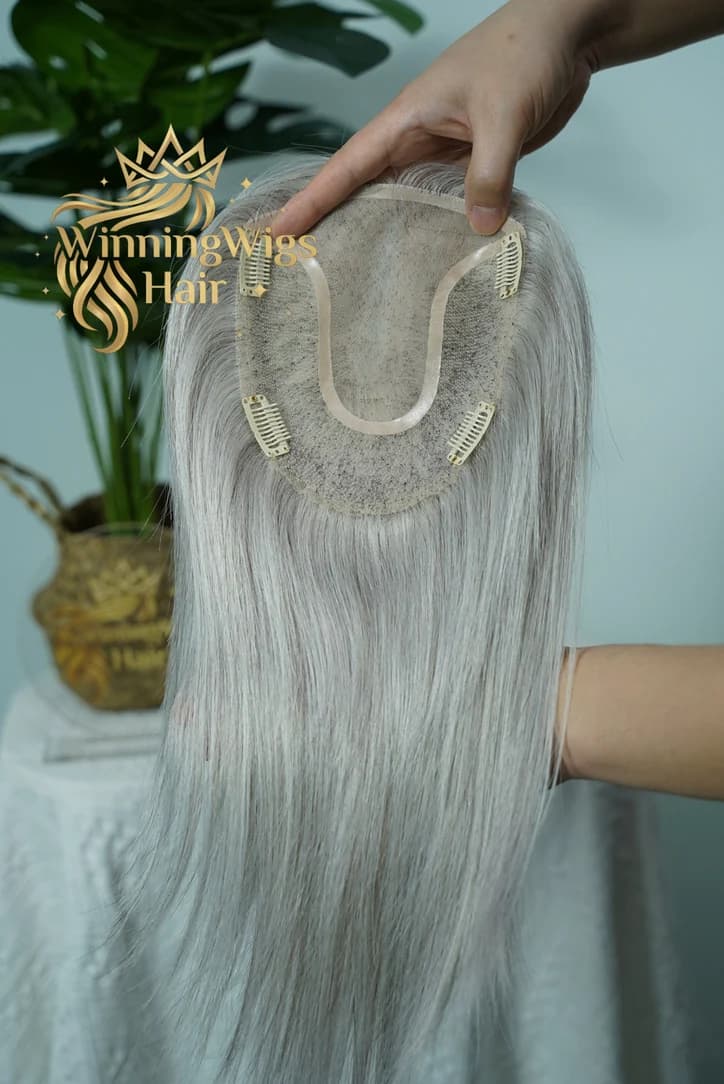
This guide compares full wigs and toppers, practical haircut options, gray and non-gray colors, and fullness that supports the intended style. The supplied photographs illustrate product details. The first shows a clip-in topper rather than a full wig, an important distinction when choosing coverage.
Start with coverage: a full wig or a topper?
A full wig and a topper solve different styling needs. Decide what must be covered before comparing color or cut.
| Your priority | Option to discuss | What needs checking |
|---|---|---|
| A complete hairstyle independent of the existing lengths | Full wig | Cap measurements, coverage, hairline and security |
| Extra coverage around the part or crown while retaining existing hair | Topper | Base area, attachment support and blending |
| A substantial overall color or length change | Full wig or a carefully planned partial solution | Whether exposed existing hair will match the result |
| A subtle addition to an otherwise familiar hairstyle | Topper or another targeted hairpiece | The location and amount of coverage actually needed |
The American Cancer Society's wig guide distinguishes top pieces that add coverage at the top from full wigs that cover the head. A topper is not simply a smaller version of every wig: it also needs to work with the hair left visible.
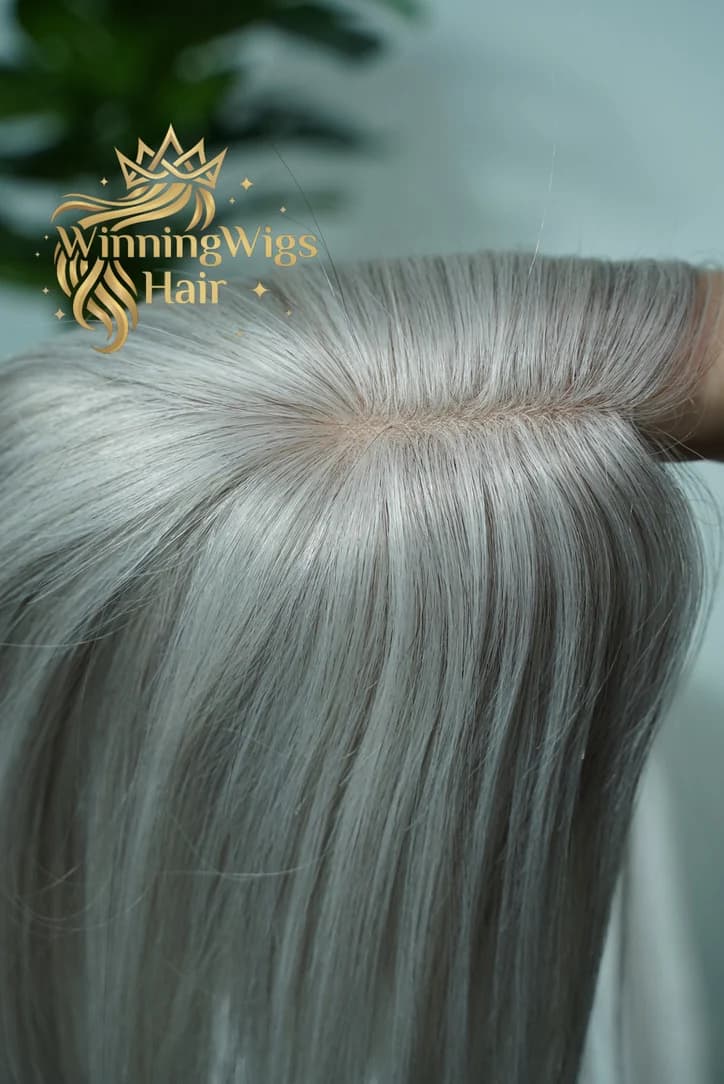
For clip-in designs, the attachment area must have enough suitable hair to support the piece. Jon Renau's topper base guidance recommends measuring the coverage area and assessing where clips will attach. Have a fitter assess suitability rather than using tighter clips to compensate for an unsuitable base.
The topper shown on the cover has four visible clips and a defined base. Its dimensions, material specification and suitability for an individual wearer cannot be established from the photograph alone.
Choose density by coverage and distribution
Why the lowest percentage is not always the best choice
Density describes fullness, but a supplier's percentage does not predict the same appearance across every product. Length, strand thickness, texture, cap construction and the way hair is distributed all influence the finish. Compare the actual sample rather than choosing a number solely because it is advertised for mature women.
Too much fullness at the crown may feel unfamiliar if you prefer fine, flat-lying hair. Too little coverage can make the base more visible or leave a topper difficult to blend. The useful question is how much hair each area needs for the hairstyle and coverage you want.
Review the front, part, crown and lengths separately
Look at the hairline transition, the width and direction of the part, coverage over the crown and fullness through the ends. Check the result while the hair is resting and when it moves. A light-looking part does not prove the entire piece has low density.
Jon Renau's density explanation illustrates how different cap constructions can produce different impressions of fullness. This supports assessing the whole design rather than treating hair weight or a density label as a complete comparison.
Our low-density wig guide explores the same coverage tradeoff in more detail. For a custom order, record density distribution alongside the approved cap, length and hairstyle so that the supplier has a useful reference.
Compare haircuts by the finish you want to maintain
Short styles, bobs and longer cuts all remain options
Choose a length because it suits your preferences and routine. The following comparisons are fitting discussion points, not age rules.
| Style direction | Why you might choose it | What to review before buying |
|---|---|---|
| Cropped or pixie-inspired style | A short silhouette with less length to arrange | Hairline, ear and nape coverage, plus how the supplied cut sits |
| Chin-length or longer bob | A defined outline that can be worn straight or softly shaped | Where the ends fall, face framing and the desired part |
| Shoulder-length layers | Movement and a choice of styling finishes | Layer placement, fullness at the ends and contact with clothing |
| Longer straight hair or waves | Continuity with a familiar long hairstyle or a new look | Detangling workload and the styling options supported by the cap |
| Fringe or side-swept front | A particular frame around the face | Visibility, comfort with glasses and any trimming needed |
A short cut is not automatically maintenance-free. A sharp bob may need its outline styled, and a fringe may need professional adjustment. Longer hair can be practical for someone who already enjoys managing it. Ask to see the selected product after the care routine you intend to use.
Use proportions and everyday accessories in the fitting
Compare front and side views, with the glasses or accessories you normally wear. Note whether hair falls where you want it and whether the part supports your preferred shape. Change one feature at a time so that you can tell whether the concern is length, fullness or positioning.
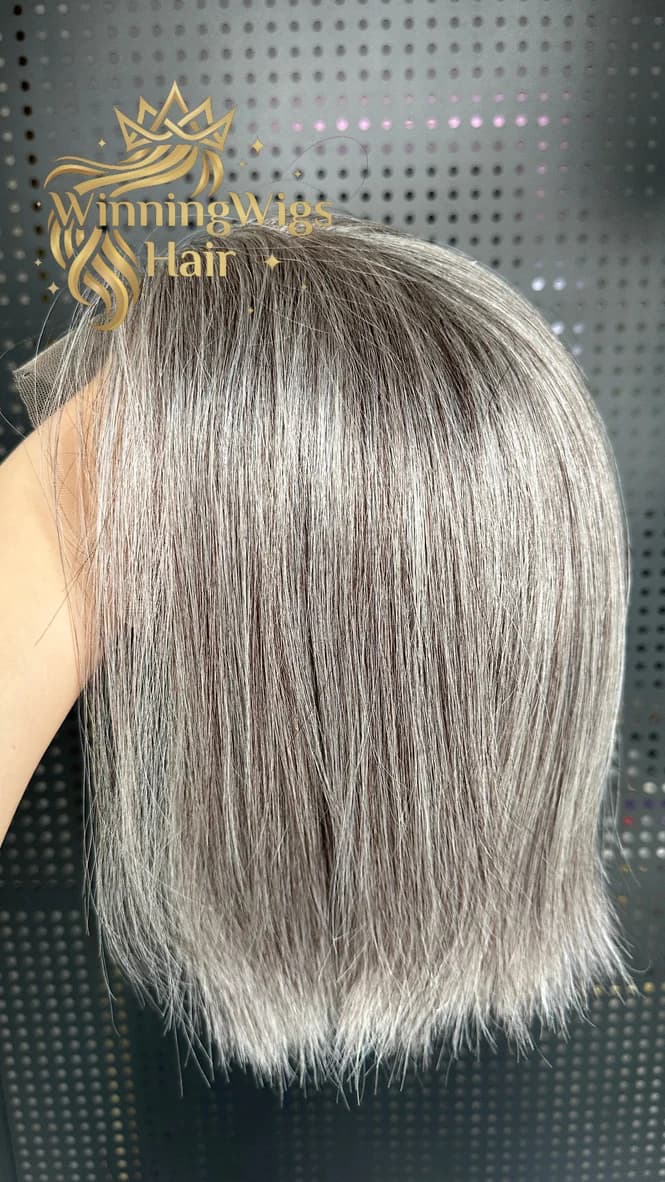
The supplied bob-length display is a shape reference. It does not show a completed fitting or establish which full-wig or topper construction would reproduce that appearance for a particular buyer.
Choose color through shade distribution, not an age rule
Staying with a familiar shade or exploring gray
Gray, silver, blonde, brunette, red and darker shades are all valid choices. Decide whether you want a close match to your existing hair, a gradual-looking transition or a deliberate change. Compare the result near the face rather than assuming a lighter shade is always preferable after 50.
With a topper, pay particular attention to the exposed front and side hair. A shade that looks suitable in the center of a sample may still differ where it meets your own lengths. Jon Renau's blending guidance recommends using a color ring and natural light to assess that match.
Check the base shade, gray blend and root treatment
Gray hairpieces can combine darker and lighter strands in different distributions. Ask how the supplier defines the blend, whether it changes between the front and back, and whether the roots have a separate treatment. A gray-percentage label describes color mixing, which is different from a density percentage describing fullness.
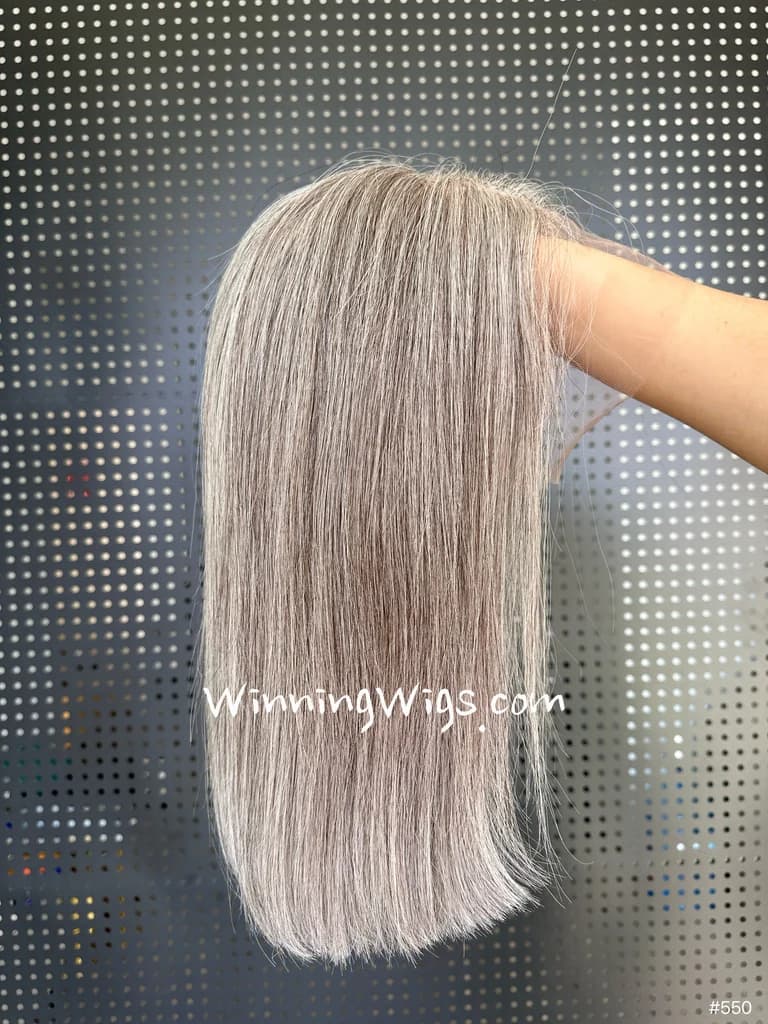
Request photographs under consistent lighting and, where possible, compare the physical swatch or sample. The supplied images were taken in different display conditions; they should not be read as a calibrated shade comparison. The #550 label visible in the fourth image is a product reference, not a universal shade standard.
Confirm the fiber used for the selected gray shade
A gray appearance does not establish that a piece is entirely human hair. Some manufacturers use different fiber mixtures for particular gray shades. For example, Jon Renau's Ignite Human Hair specification lists human-hair and heat-friendly synthetic mixtures for its gray blends. That is a brand-specific example, not a description of the photographs here.
Ask for the composition and care instructions of the exact shade ordered. This matters before heat styling, coloring or comparing the maintenance of two otherwise similar-looking pieces.
Put fit and comfort ahead of further customization
For a full wig, follow the seller's diagram for circumference, front-to-back and ear-to-ear measurements. Compare them with that product's chart, not a size label borrowed from another brand. The American Cancer Society's guide notes that brand sizing differs and that fit may change when the amount of existing hair changes.
For a topper, assess base coverage and attachment locations separately from hair length. Discuss any pressure, slipping or difficulty operating the fittings with a specialist. A longer piece does not necessarily provide a larger base, and increasing density does not correct the wrong attachment position.
During installation preparation, arrange existing hair and any appropriate liner as instructed. Check the front, sides and nape before deciding that the hair needs thinning or the lace needs further alteration. Our natural-looking wig guide explains that sequence in more detail.
Match the fiber to the care routine you prefer
Conventional synthetic hair may suit someone who wants to repeat a supplied style with less restyling. Human hair can support suitable styling services but often involves more washing, drying and finishing work. Heat-friendly synthetic and blended products require their own instructions; they should not be treated as interchangeable with either category.
Macmillan's wig guidance describes the maintenance differences and notes that human hair may need professional cleaning and styling. Use those differences to discuss the actual routine rather than ranking every human-hair wig above every synthetic design.
Before purchase, ask for the permitted tools, care products, washing method and drying procedure. Include any salon visits, fitting, trimming and accessories in the budget. For longer-term planning, our human hair wig lifespan guide separates hair condition from cap wear and explains why a maximum lifespan is not a guarantee.
Use a repeatable fitting and sample review
Compare the result in ordinary conditions
At a fitting or sample review, use a short checklist:
- Confirm the cap or base and the intended attachment.
- Assess the part and coverage with the hair resting naturally.
- View the front, sides and back in consistent lighting.
- Check the length and fringe with your usual glasses or accessories.
- Gently turn your head to assess stability during ordinary movement.
- Confirm the care routine and any work still required before wearing.
As an illustrative brief, a buyer might request a gray bob with restrained crown lift, a side part and enough coverage to conceal the base during movement. The next step is to compare those details on the actual sample. It would be premature to change only the density percentage without checking the fit, hair direction and styling. This is a hypothetical evaluation example, not a customer test result.
Review the return conditions before alterations
Check what the seller permits during assessment, including trying on the piece, removing tags, washing, trimming lace, coloring and applying adhesive. Stock and custom orders may have different terms. Photograph an unexpected issue and contact the seller before trying to correct it yourself.
If you are buying your first piece, our wigs for beginners guide provides a broader purchase-to-fitting checklist.
For construction-specific questions, our lace top wigs guide compares top panels, front lace, silk-style tops and the sample details to confirm before ordering.
What professional buyers should specify before ordering
Translate customer requirements into a usable order brief: full wig or topper, cap or base measurements, attachment, parting area, density distribution, cut, length, shade reference, fiber composition and supplied preparation. A lifestyle description helps explain the intended product application, but the approved specification should also identify physical details.
WinningWigs' HD Lace Top Wig, Custom Wig program and Mono Topper pages provide construction references for professional buyers. They do not identify the exact products in the supplied photographs. Confirm the selected model, gray-shade availability and preparation before approving a quote.
Our published quality process describes visible-condition review, combing performance, curl consistency and color comparison under standard inspection lighting. For additional factory testing, agree the sample, procedure and records first. A combing or wash review should not be presented as proof of comfort, an exact density or a guaranteed service life.
During shipment inspection, compare the delivered shade, construction, length, finish, labels and care information with the order and approved sample. Keep the original photographs and reference swatch. This creates a delivery baseline for later questions about color or construction without inventing a long-term performance result.
FAQ
What are the best wigs for women over 50?
The best option is the one that matches your coverage, fit, hairstyle and care preferences. Compare the actual product and fitting support rather than an age label. A full wig, a topper, a short cut or a longer style can each be appropriate for different requirements.
Should women over 50 choose short wigs?
Only if they prefer the look and routine. Bobs, cropped styles, shoulder-length layers and longer hair remain options. Check the cut on the selected construction and ask what daily styling it needs. Shorter length alone does not guarantee an easier fit or a more suitable appearance.
Is gray better than blonde or brunette?
There is no universal best color at a particular age. Gray may preserve or introduce a preferred look, while blonde, brunette, red or darker shades may better match another buyer's preference. Compare physical references near the face and consider exposed existing hair if choosing a topper.
Is low density always more natural?
No. Fullness needs to support the intended coverage and style. Hair direction, cap construction, length and texture all affect the result. Assess the front, part, crown and ends separately before reducing density; too little coverage can make the base more apparent.
How do I choose between a wig and a topper?
Choose according to the coverage and blending needed. A topper works with existing hair and needs an appropriate attachment area. A full wig provides a more complete hairstyle. Have a fitter assess the intended construction rather than choosing solely from a top-view photograph.
Does a gray wig contain only human hair?
Not necessarily. Gray describes appearance, while composition describes the fibers used. Request the specification for the exact shade, including any synthetic component, and follow its own heat and care instructions. Neither a gray photograph nor a human-hair collection name establishes every shade's composition.
Can a glueless wig be a suitable choice?
It can, when the design fits and its intended security method suits the wearer. Glueless does not remove the need for measurement, preparation or adjustment. Ask how the actual model stays in place and assess it during a fitting before relying on the label.
Conclusion
Choosing wigs for women over 50 is a product-selection decision built around individual style and practical requirements. Start with coverage, then refine density distribution, cut, color, construction and care. Use the selected sample and a proper fitting to bring those decisions together.
For wearers, that approach makes the purchase easier to evaluate. For salons and brands, a clear brief, honest sample review and delivery records help connect a desired appearance with a product that can be assessed and reordered.
LET'S TALK ABOUT YOUR PROGRAM
Ready to turn product questions into a clearer brief?
Share your target customer, product category and requirements. Our team will help structure the next sample or quotation conversation.